🪧 How To Start a Revolution in 2026
Ordinary people can run society — but only if we build the structures to let them.

This is my most complete piece of work since prison. I’ve just published a three-hour video laying out, in practical detail, how real political change actually happens in the conditions we now face: climate collapse, democratic breakdown, and the rise of authoritarian politics. The full video is linked here, and there’s also a podcast version for those who prefer to listen. If you don’t have time for the full three hours (though I do recommend it), I’ve included a detailed written summary below, drawn from the transcript.
This is the framework I’ve been developing over the past months 6 months since my release: not a rally speech, or theory for its own sake, but a usable strategy. If you want an update on where my thinking is now, this is it.
People Power Remakes The World
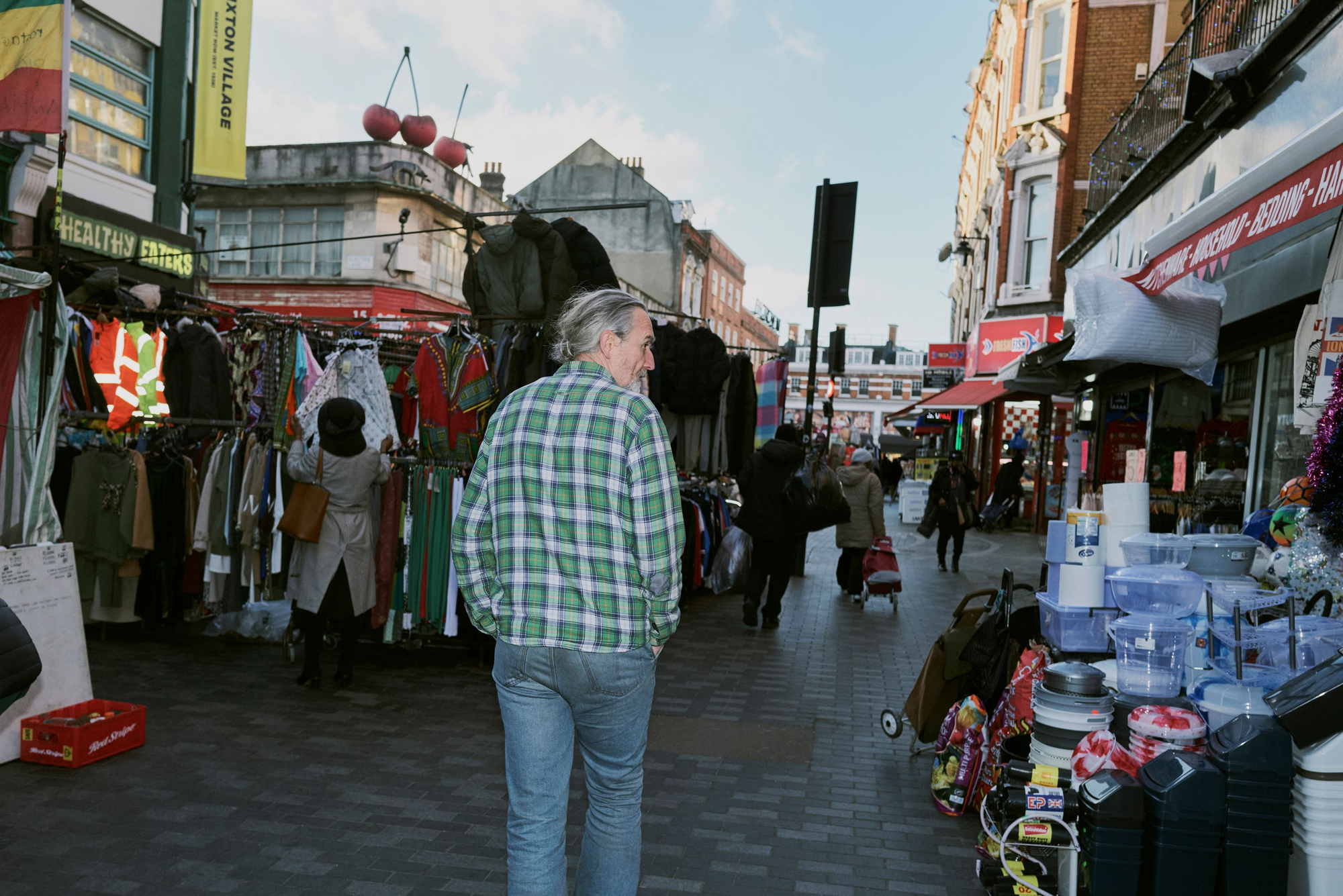
I haven’t made a video like this for a while. For fourteen months, I was in a British prison. I came out in August and went straight back into organising — on the ground, in Brixton — because theory only matters if it survives contact with reality.
What follows is the distillation of that period. It’s recorded in December 2025 and reflects the clearest thinking I’ve arrived at so far about how real political change actually happens: why movements fail, why some suddenly work, and what has to be consciously designed if we want to win in the conditions we now face.
There is a loose structure of Context, Mobilisation, Organisation and Endgame, but this isn’t a performance or a pitch. It’s me thinking out loud — carefully, practically — about power, organisation, leadership, and rupture, based on history and lived experience. If you’re looking for slogans, this won’t help. If you’re trying to work out how change actually happens, this is where I’d start.
The Context
Across the West, the far right is surging. The climate crisis has crossed thresholds most politicians still refuse to name plainly. Democracies are hollowing out under debt, dysfunction, and the general sense that nothing can be done. AI and economic shocks are adding to the instability. People feel it, and many cope by switching off, avoiding it, or grabbing hold of fantasies.
That avoidance won’t last. Reality doesn’t negotiate. Ruptures are coming.
So the question is not whether things will change. The question is who will shape the change when it arrives. A lot of activism today is stuck in a familiar pattern: a thousand worthy projects, campaigns, and local initiatives — each doing good work, but often without a shared strategic picture. There’s an implicit belief that if enough groups do their “bit”, a bigger force will somehow emerge on its own.
Maybe. But probably not.
If you want mass mobilisation, you don’t get it by accident. You get it because someone, somewhere, has designed a pathway that connects the small to the large: local mobilisation that scales, networks that cooperate, and a credible route from community power to state power. Strategy isn’t a luxury. It’s the thing that turns effort into momentum.
This is also why I’m not interested in spending three hours listing how awful the “bad guys” are. People already know. What matters is building the conditions for something better — not just resisting collapse, but remaking the world as the old order breaks down. “People power” is simply the name for what happens when ordinary people organise themselves into a force that can reshape reality.
And yes: this is technical. It’s about the nuts and bolts. It’s aimed at people who actually want to do the job — not just comment on it.
The core argument in this first section is simple: Social reality changes in non-linear jumps. Most of the time, you push and nothing moves. Your project stays at 20 people. Then 22. Then 26. It feels like failure. That’s where left defeatism grows: “See, nothing works.” However, sometimes a feedback loop kicks in. The same work suddenly multiplies. 26 becomes 32. Then 120. Then 2,000. Then 200,000. Nothing happens — and then it goes boom.
The question is whether we’re going to sit around waiting for that boom, hoping it appears through luck and chaos, or whether we’re going to learn how to design the conditions for non-linearity: the structures, habits, recruitment methods, training, and political framing that produce positive feedback loops.
That’s what the rest of the video is trying to do.
One more piece of context matters. There’s an exhaustion in the wider climate and democracy space. People can’t hold existential threat in their minds all day without shutting down. Liberal politics often retreats into technical talk, avoiding the existential implications. The far right offers an escape hatch: denial, nationalism, scapegoating. It feels simpler than looking at reality.
But again: it won’t hold. Physical systems don’t care about avoidance. The ruptures will come anyway — and when they do, political maturity matters. People will ask: who decides? Who holds power? How is it exercised? What replaces the broken system?

The Theory
That’s why there’s a strategic shift towards the local and the social: going to the people, rooted in bread-and-butter issues — housing, food security, cost of living — and building coalitions in real communities, not just online and not just inside activist bubbles.
This comes with a tension movements have always faced: if you only do “pure” politics, you become irrelevant; if you only do immediate reforms, you risk becoming managerial and losing the systemic horizon. The job is to combine the strengths of both — to meet people where they are and build a route to deep structural change.
That’s the work. That’s the design challenge. And that’s what this project is about.
If you strip all the mysticism out of organising, a lot of it comes down to one question: what actually multiplies? What’s the small input that reliably produces a bigger output next week, next month, next year?
That’s what I mean by “ratios”. You go into the real world, you try things, and you look for the repeatable moves that create a positive feedback loop. Here’s the blunt reality. Mass movements don’t sustain themselves on vibes. They need infrastructure: training, meeting spaces, materials, travel, comms, coordination. And that requires money.
Most people can’t work full-time on movement-building because they have to pay rent. So the movement has to become self-sustaining, not dependent on a few generous rich people with idiosyncratic politics. In practice, that means ordinary people paying £10 a month (or whatever the local equivalent is), month after month, because they trust the project and feel part of it.
If you don’t solve that, you stay stuck running a little local project with 20 people. Useful, good, even beautiful — but it won’t stop fascism or meet the scale of what’s coming.
So the real organising problem becomes: what are the A, B, and C that get thousands of people to commit? Not once, but consistently.
How you find the ratios: pilots, prototypes, repetition
You don’t get these answers by sitting in a room for six months “thinking strategy” as if society is a machine you can map perfectly. It isn’t mechanical engineering.
You get answers by running pilots.
A pilot is simply: you go into the social space and you do something. You knock doors. You run a petition stall. You lobby a councillor. You hold a meeting. You try an ask. Then you watch what happens.
Often it doesn’t work. Good. Now you know.
More often it half works, half doesn’t. Annoying — but that’s where the gold is. You tweak, iterate, repeat. Over time you find the small design choices that double turnout, increase conversions, build commitment, and deepen leadership.
This is the real secret behind most “overnight successes”. It’s not genius. It’s iteration.
Human nature: sociability and proximity
Two simple determinants sit underneath mobilisation:
Sociability: people talking to each other, not just listening to one person talk at them. When people relate, relax, start trusting each other, and feel seen, you create the texture through which mobilisation spreads.
Proximity: how close it is in time, emotion, and space. If the next action is a month away, people forget. If the relationship feels transactional, they drift. If the meeting is three miles away and awkward, they won’t come. Close the gaps and participation rises.
This is why “telling people what to do” usually fails. People don’t join because you have The Truth and a megaphone. They join because they feel agency, connection, and ownership. The best tradition on this is Paulo Freire: you go to people, you listen, you create conditions for self-directed radicalisation — not top-down instruction.

“Isn’t this just manipulation?”
There’s always a kernel of truth here. All social interaction involves framing. But there’s a bigger reality: the social space is already manipulative. Neoliberal life trains people to conform, compete, individualise, and accept powerlessness. It erodes creativity and collective agency, then calls the resulting misery “personal failure”.
So the point of good organising design isn’t to impose control. It’s to restore agency — especially collective agency. That’s what liberation looks like in practice: people discovering they can act together, and that action matters.
I’ve seen this again and again door-knocking in Brixton. People are often progressive, compassionate, pro-social — and also despairing and cynical. Not because they don’t care, but because they don’t see a pathway. They’ll say, “We can’t do anything about that. It’s structural. It’s just how things are.” That resignation eats away at people.
Good organising interrupts it. Not by lecturing, but by offering a lived experience of “we can do something”.
Revolution as a normal word again
Part of this work is cultural. In the 19th century, calling yourself a revolutionary wasn’t weird. It was a normal political identity in societies that knew major change was needed.
In the late neoliberal period, “revolution” became a joke: end-of-history thinking, the idea that the system is basically fine and only needs tweaks. So we got the safe word: “activist” — quaint people making a fuss while the grown-ups run the world.
But there’s nothing more “active” than actively destroying the world.
A useful, non-romantic definition of revolutionary is simply this: someone who wants to change the constitution — the system that produces policy — not just lobby for better policy inside a broken system.
Reformism tries to get nicer people into parliament. Revolution changes what parliament is, who decides, and how decisions are made. In the UK that might mean abolishing the House of Lords. More broadly it points towards sortition and citizens’ assemblies: redesigning decision-making so power stops being a private club.
Revolution isn’t utopian. It’s not a promise of permanent ecstasy. It’s a practical claim: a different system is more effective, and that effectiveness is what prevents mass collapse. That’s the whole point.
And revolutionary change doesn’t have to be violent. In fact, if it turns violent, it usually stops being a revolution and becomes something else: a power struggle, a civil war, a new tyranny.
So the question becomes: how do you mobilise people fast enough to beat the far right and force structural change?
Here I’m talking about mobilising a local, geographical community: depressed rural towns, small cities, big urban areas — places with plenty of progressive sentiment and plenty of alienation. People aren’t reactionary, they’re exhausted. They can’t see a pathway to collective action.
The project is to get those people moving. If you can do that at scale, you’re in the ballpark of an endgame.
There’s a default ideology in community organising: go slow, build for years, avoid ruptures, avoid confrontation, don’t touch elections. And to be clear: there’s a lot to respect in that tradition. Deep roots matter. Long-term organisers are often the best people in a place.
But it’s not enough for the moment we’re in.
In response to the far right, a slow model won’t reliably produce the level of mobilisation and collective power required for structural change. Three problems keep showing up:
- Slowness becomes the culture. “We’ll meet next month.” Momentum dies. People forget. The system carries on.
- Fear of confrontation becomes paralysis. A lot of decent, established people worry that confrontation tears the community apart. They’re not wrong that social fabric is fragile. But the counter-truth is harsher: if you suppress confrontation entirely, pressure builds and you get the worst version later — an explosion, a riot, a breakdown. Better is limited, disciplined, nonviolent confrontation, ongoing and intentional, rather than a sudden uncontrollable rupture.
- A strange humility: “we’re just the peasants.” People act like elections are for “political people” — the big parties — while the rest of us stick to demos and polite lobbying. But in a democracy, anyone can stand. The resistance is cultural, not logical: fear of “splitting the left”, fear of being told off, fear of stepping out of line. Yes, elections carry risks. But treating them as off-limits is an inertia, not a principle.
Sometimes a wider rupture breaks the spell and everything accelerates. Sometimes it doesn’t. So the question is: can we create a proactive, pro-social rupture ourselves? Not violent. Not chaotic. A designed break in the normal pattern.
Why going fast works
I’m not saying “always go fast”. I’m saying: there are times when speed is the smarter design. Three reasons:
1) Speed solves the collective action problem. Most people won’t door-knock because it feels pointless if nobody else is doing it. It’s a coordination problem. Mrs Jones doesn’t know Mr Harris will join her. Everyone sits at home thinking action is lonely and futile.
But once a visible number of people are doing it, it flips. It becomes sociable. It becomes normal. It becomes exciting. The trick is getting past the lonely phase quickly — so people can see it’s happening.
2) Speed creates drama. If you meet in January and say the next meeting is April, nothing enters the local memory. If you collect thousands of signatures in two weeks, plaster the area with posters, and pull 150 people into a room, you become a talking point. People repeat what’s unusual.
Drama isn’t spectacle for its own sake. It’s social transmission.
3) Speed stops bureaucratisation. If you slow down, the organisation starts defending itself rather than pursuing the aim. Meetings fill with risk-management: “Will we lose funding? Will the police come? Will we damage our reputation?” The organisation becomes the identity, not the work.
In an existential crisis, this caution becomes the bigger risk — while the far right moves fast and sets the tempo. Revolutionary activity is not “steady community organising”. It’s strategic disruption of inertia — think Martin Luther King in Selma: honour the organisers, but break the stalemate by escalating pace and pressure, nonviolently.
That’s the entry point to a mobilisation campaign.
Building Assemblies
The first step isn’t preaching. It’s listening — not as a moral posture, but as a design principle.
If you knock doors saying, “Hi, I’m Roger, I’m a socialist, here are our policies, join us, vote for us,” you trigger resistance. Even if you’re right. Even if your policies are good. That’s not the point.
The point is human nature: people become open and motivated when they get to speak. When they talk about their lives, they warm to you. They feel engaged. They feel respected. And then they’ll do a small next step — a meeting, a petition, a chat — because it feels like their choice.
So the doorstep is built around two questions:
- What are one or two good things about living here?
- What are one or two things you’d improve?
Then you invite them to something that matches that energy: a public meet-up in an assembly format, small groups, gentle, sociable, local. Not a lecture. A room where they can talk.
That’s it: listen, mirror, invite.
And the detail matters. The exact words matter. The flow matters. Because you’re not doing this ten times — you’re doing it thousands of times.
In Brixton, the team did this roughly 3,000 doorsteps in six or seven weeks. That gives you something you can’t get by “thinking in a room”: real information about what people care about, what language lands, and what’s possible.
Here’s the non-linear bit. You can do weeks of work and get 10–15 people at a meeting. People will tell you it’s failing. But you’re building the first feedback loops: a little curiosity, a little talk, a little attention. Then the rhythm starts to matter more than the numbers:
That regularity creates momentum. If you do three assemblies and stop, you look like outsiders running an experiment. If you keep going, you become part of the local reality. People start getting pulled into the vortex of attention.
And then, after a few assemblies, you stop guessing and name the campaign — the issue that can unify the area. In Brixton it surfaced as homelessness, addiction, and mental health — tied, in large part, to housing.
One of the biggest mistakes people make with assemblies is stopping too early. They hold a few meetings, identify big problems, nod solemnly — and then hold more meetings. Nothing moves. People drift away. Cynicism grows. Assemblies start to feel like a dead end.
That’s not because assemblies are useless. It’s because they’ve been badly designed.
Assemblies only work if they are part of a moving sequence. You don’t just move fast inside each step — you move fast between steps. You already know what comes next before the current moment has finished.
In Brixton, we didn’t knock on 3,000 doors just to “listen”. We did it to identify which issue would mobilise at scale. Very quickly it became obvious: homelessness, addiction, and mental health. Those weren’t abstract policy concerns — they were visible, daily, unavoidable.
At that point, everything changed.
Instead of just door knocking, we pivoted. We put up 300 posters across the area. Not two. Not ten. Hundreds. The message was simple: this is a serious problem, and there’s a meeting about it.
The result surprised even us. 150 people turned up.
That doesn’t happen by accident. It happens because momentum compounds. By that point, people had heard about us multiple times — from neighbours, WhatsApp groups, street posters, word of mouth. Once people hear about something five or six times, it crosses a psychological threshold. They stop thinking “what is this?” and start thinking “maybe I should go”.
That meeting changed the social geometry of the space overnight. Councillors and MPs turned up without being invited — not because we asked nicely, but because power pays attention when people start organising at scale.
This is where another dynamic kicks in.
Whenever something starts to grow non-linearly, two groups try — consciously or unconsciously — to slow it down.
The first are local gatekeepers: long-established administrators, charity managers, councillors, professional organisers. Often decent people. Often hardworking. But they are used to controlling the pace of change. Assemblies threaten that control, because creativity shifts away from institutions and into the room.
In Brixton, one councillor broke the assembly format and tried to address everyone directly — re-establishing hierarchy, offering warm words, dampening energy. Not because he was evil, but because that’s how power behaves when it feels challenged.
The second group are the purists. The endlessly critical. The people addicted to asking clever questions instead of proposing action. They don’t block things outright — they slow them down through overthinking. In revolutionary moments, cleverness is less important than momentum. If you think too much, you don’t move.
The only reliable way to get past both groups is speed.
If you move slowly, gatekeepers have time to intervene. If you move fast, the energy outruns them.
After the big meeting, working groups formed organically: outreach, social media, street teams, direct contact with people experiencing homelessness. We didn’t wait for permission. We didn’t over-design. We let people act.
Then we hit the next problem: money.
The original idea — that donations would flow naturally from assemblies — didn’t work at scale in this context. So we pivoted again. This time, we used petitions.
I’ve criticised petitions before, and for good reason. Most are useless. But in this context, the petition wasn’t symbolic — it was material, local, and relational.
People signed on paper, on the street, about a problem they could see with their own eyes. Then they scanned a QR code and joined a WhatsApp group. That gave us a phone number — and phone calls change everything.
When you ring someone, you can build a relationship. You can explain the campaign. You can ask for a small donation — £1 or £2 a week. You can invite them to volunteer.
What emerged was a dynamo.
For roughly every two hours of calling, we gained one active volunteer. For every hour, we raised around £8 a month in regular donations. That volunteer then went out petitioning, which produced more contacts, which produced more volunteers and more money.
Labour created money. Money funded labour. Momentum fed itself.
Suddenly, a project that started with three people knocking on doors was generating thousands of signatures, dozens of volunteers, and a stable monthly income. And crucially — it was replicable. Anywhere.
But here’s the hard truth. A local campaign — no matter how successful — is not system change. Councils will stall. Politicians will smile and say no. Performative campaigning leads nowhere.
So you reach a fork in the road.
One path is civil resistance — which I’m not going into here due to my bail conditions. The other is political power.
If institutions refuse to respond, then you stop asking. You stand in elections.
That’s the next step. Not as career politicians, but as organised communities with legitimacy, numbers, and money behind them. Assemblies generate the mandate. Campaigns generate the base. Elections become a tool, not an identity.
This is how revolutions actually begin — not with slogans, but with sequences. Design. Speed. Feedback loops. And the courage to move before permission is granted.
The demands didn’t come from us. They came from the room. After hundreds of conversations and multiple assemblies, about 150 people agreed on something concrete: rough sleeping in Brixton should be reduced by 75% within a year. Not a vague aspiration. A measurable target.
So we did what democracy is supposedly for. We wrote it up as a charter, five or six pages, clear and grounded in thousands of local conversations. Then we tried to hand it in to the council.
They locked the doors early because they knew we were coming.
That moment is important. Because it shows how power actually behaves when faced with legitimacy it didn’t authorise. We handed the charter to security guards instead.
Next step: we contacted every Labour councillor in Lambeth. We offered civilised conversations. We booked meeting rooms, including one inside the town hall itself. We made it easy.
They didn’t turn up.
At first, the silence was probably meant to make us go away. But then the campaign gained traction online, and the tone shifted. Suddenly there were warm statements about how much they were “already doing” on homelessness. Then the reframing began: this wasn’t a community process, it was “political”; it was outsiders interfering; it was somehow illegitimate.
This is the standard neoliberal routine. As long as you’re polite and ineffective, you’re tolerated. The moment you start to matter, the rules change.
So you reach a fork.
If institutions refuse to act on legitimate demands, you stop asking. You stand against them.
Why symbolic elections fail
The conventional approach goes like this: put up one or two independent candidates, test the waters, be “realistic” about resources.
That doesn’t work. Not because people are stupid, but because this logic ignores non-linearity.
Standing in three wards out of twenty-five doesn’t threaten power. It’s performative. It signals caution, not seriousness. Parties like the Greens have been trapped in this loop for decades: “target wards”, incrementalism, permanent marginality.
But we are not in normal times.
We’re facing overlapping crises: ecological collapse, social breakdown, and the rise of the far right. Acting as if you intend to win becomes part of the strategy. When you act at scale, labour and money follow scale. When you hedge, they don’t.
This isn’t bravado. It’s causal.
If you knock on doors saying, “We might run a candidate here,” a handful of people respond. If you knock on doors saying, “There’s momentum across Brixton, we’re standing candidates everywhere, and hundreds are coming to the assembly,” five or ten times more people turn up.
Excitement creates reality. Then reality reinforces excitement.
There’s a sweet spot here: not reckless fantasy, not cautious boredom. Credible ambition.
Elections are not the strategy — they’re a lever
People hear “election campaign” and imagine a linear script: knock doors, pick candidate, win seat. That’s comforting, and wrong.
The real strategy is holistic. Elections create social effects beyond votes. They lift cynicism. They generate hope. They reintroduce fluidity into spaces frozen by resignation.
That social fluidity is where structural change becomes possible.
The model we’re working with has three interlocking elements:
- Local campaigns — before, during, and after elections
- The social commons — mutual aid, sports clubs, food groups, social nights, everyday community life
- Elections — as one tool among others, not the centre of gravity
The aim is not just to win seats. It’s to build a permanent, organised social force that politicians have to reckon with.
In Brixton, people are now talking about creating a standing community organisation: not a business, not a charity, not a party — but a body that represents the social space itself. Its functions are simple and radical:
- Coordinate community action
- Overcome the collective action problem
- Run election campaigns
- Maintain a parallel community assembly alongside the council
Not a consultation. Not a talking shop. A constituted body that continuously exerts pressure.
This is the difference between “giving voice” and having power.
Why social power must dominate political power
This is the key design principle most parties get wrong.
Political structures must be subordinate to the social base, not the other way around. Otherwise, oligarchy sets in: a central clique consolidates control, members drift away, mobilisation collapses.
You can see this degeneration clearly in many mainstream parties today.
The counter-example is Bolivia. There, dense networks of unions, cooperatives, and community organisations created a political instrument to take state power — and retained control over it. Candidates, programmes, direction all flowed from the social base upward. The result was repeated electoral success and sustained mobilisation.
That’s the paradigm shift required to counter the far right.
This isn’t about “Roger putting up candidates”. It’s about redesigning the relationship between society and the state.
The numbers matter because they tell the truth
Good strategy shows up in ratios.
Here’s what we know works.
In a typical UK ward of around 10,000 voters:
- 200 posters across 50 streets create baseline recognition
- Roughly one person per poster turns up to a launch meeting
- Door-knocking adds another one attendee per two hours
That reliably gets around 100 people in the room.
From there:
- Around 20% become regular door-knockers
- 40 door-knockers × 2 hours a week = 1,600 doors a week
- In six weeks, you’ve knocked every door three times
That’s enough to win a ward — assuming you’re a credible local alternative.
Add phone follow-ups via QR codes and WhatsApp, and you create another feedback loop: more volunteers, more donations, more reach. About 25% of people will give £10 a month at meetings. Phoning adds more.
Scaled across multiple wards, this model produces tens of thousands per month, not as campaign cash, but as funding for a permanent local organisation.
And that’s the crucial framing.
You’re not asking people to donate to an election. You’re inviting them to build an organisation that outlasts elections.
The vote is a moment. The social structure is the point.
Elections matter here not because voting itself changes everything, but because elections accelerate commitment.
When people believe something real is happening, they don’t just turn up once. They keep going. They door-knock again. They bring friends. They give a small amount of money each month. That steady income then allows organisers to work full time, which is the condition for building anything at scale.
Without full-time organisers, volunteer networks stall. With them, momentum compounds.
People sometimes push back on this. They say: we tried meetings, no one came; we asked for money, no one gave. The conclusion is usually that “people aren’t ready”.
That’s wrong.
What’s changed is the context. Social repression is increasing year by year. People are angrier, poorer, more alienated. The reason they don’t mobilise isn’t apathy — it’s the collective action problem. Everyone feels stuck acting alone.
The breakthrough comes when people are given real agency, not symbolic participation.
Agency means two concrete things.
First, communities choose their own candidates.
Instead of announcing a name, you knock on doors and ask a different question: Who do you trust around here? Who actually does things? In a neighbourhood of fifty streets, people know the answer. Someone always comes up — the woman who runs community groups, the guy who helps neighbours, the local organiser no party ever selects.
From there, the process is simple. A small number of nominations lets someone stand in an open local primary. Anyone from the ward can attend. It’s held in a church hall or community centre. There’s food. Kids run around. Candidates speak briefly. Neighbours speak for them. Then the room votes.
Everyone claps — because everyone chose.
This is what democracy actually looks like. Not party members selecting a candidate in private, then marketing them to the public, but someone emerging from the community, authorised by it.
That ethical legitimacy turns out to be a strategic gift.
People who helped choose a candidate are far more likely to knock doors for them. They’re far more likely to donate. It’s their candidate, not a product being sold to them.
Second, communities choose the programme.
Door-knocking generates data. You ask people their top issues. You aggregate the responses. You bring them back to an assembly. People discuss priorities and agree on a short list. That list becomes the programme.
The candidate then signs a public commitment to follow it.
This doesn’t produce chaos. If anything, it produces clarity. When people deliberate together, priorities converge. Most communities arrive at broadly pro-social demands once discussion happens openly.
Now scale that across multiple wards.
Some issues remain local. Others repeat everywhere. You aggregate again at area level and reduce the programme to a small number of clear demands — five at most. Simple enough to remember. Strong enough to mobilise around.
At this point, something interesting happens.
You start to see the real weakness of established power.
In places like Lambeth, around 70% of people don’t vote. Labour dominates not because it’s loved, but because alternatives aren’t organised. In a ward of 10,000 people, Labour often wins with around 1,500 votes. That’s 15% of the population.
Once you understand that, the maths flips.
If your campaign can mobilise even a fraction of non-voters — through door-knocking, assemblies, phone calls — winning becomes entirely realistic. You don’t need a majority of the population. You need coordination.
This is why momentum matters so much. Once people realise the emperor has no clothes, things move very fast.
Alliances matter too.
In most places, the left fragments itself: independents, Greens, local parties all competing for the same votes. That guarantees defeat. The answer isn’t a single hegemonic party, but coordination without absorption.
There are three workable models.
One is friendly competition: independents and Greens encourage voters to split their votes strategically rather than attack each other.
Another is open primaries: multiple progressive candidates stand, the community chooses, and the rest step aside.
The third is pre-agreed coordination: different groups focus on the wards they’re strongest in and support each other elsewhere.
All three preserve autonomy. None require surrendering identity. They create what you might call a closed ecology: different organisms, cooperating at election time, independent the rest of the year.
This is how it works in places like Bolivia. Strong social movements don’t dissolve into parties — they create political instruments when needed and retain control over them.
Once you add social media, community organisations, churches, sports clubs, food groups, and mutual aid networks into the mix, momentum accelerates again. These groups already exist. Many are already under threat from councils and cuts. Supporting an independent, community-rooted campaign aligns with what they believe in anyway.
They offer meeting spaces. They share content. They mobilise their members. They donate. They legitimise.
At that point, the campaign is no longer “a political project”. It’s a social force.
This is how councils get overturned in months, not decades. It’s how it’s happened in places like Frome, North Devon, Madrid. Non-linear dynamics take over. Excitement generates participation, which generates more excitement.
But there’s one final piece.
Winning elections isn’t enough. Ordinary people don’t automatically know how to navigate local government, bureaucracies, or entrenched interests. If you send untrained councillors into that environment, they get eaten alive.
So candidates must commit to serious training before standing. They need to understand how councils work, how power blocks decisions, how developers and finance operate, and how to keep authority anchored in the community rather than drifting upwards.
The goal isn’t to manage the system better. It’s to use political power to rebuild the social space so communities don’t depend on it in the first place.
That’s the real programme.
Winning elections is not the end of the project. It’s the beginning of a deeper shift in power.
Alongside elected councillors, a parallel democratic structure needs to be built — one that mirrors the council but is rooted directly in the population. This isn’t symbolic. It’s practical.
Take a borough like Lambeth. There are around sixty councillors across twenty-five wards. Most wards have two or three councillors. A parallel assembly simply matches that structure: if a ward has three councillors, three residents are selected — not elected, but chosen by sortition.
Sortition means random selection. Everyone has an equal chance of being chosen. In practice, you select streets at random, knock doors, and invite people to take part. Most will say no. Some will say yes. From those who agree, you use basic demographic balancing — gender, income, ethnicity — to arrive at a group that broadly reflects the ward.
This matters because representation isn’t abstract. When a body looks like the place it represents — working-class people, migrants, renters, carers — it carries immediate legitimacy. The voices usually excluded from politics are present by design, not as an afterthought.
These parallel councillors don’t replace elected ones. They shadow them.
They study how the council works. They sit in on committees. They learn budgets, procedures, choke points. Alongside that, they convene citizens’ assemblies — issue-focused groups of forty or fifty people who examine topics like housing, drugs, or public safety. These assemblies hear from experts, frontline workers, and affected residents, then deliberate and propose grounded strategies.
There’s a large body of evidence showing what happens when you do this properly: people converge on pragmatic, pro-social solutions far more consistently than party politics ever suggests.
But participation must scale beyond the room.
Most people don’t have time to attend assemblies. So the process needs a broadcast layer — what I call the “World Cup model”. Assemblies are filmed. Each day, short highlight videos are released: moments where testimony lands, arguments shift, or decisions crystallise. People watch what matters to them — housing, drugs, care — just as they watch highlights rather than full matches.
The wider community then feeds back: voting online, commenting, responding. This doesn’t give them formal power, but it creates continuous democratic pressure. Assemblies don’t deliberate in isolation. They feel the pulse of the borough in real time.
Around this sits a wider borough ecology: neighbourhood meetings, mutual aid, food co-ops, energy co-ops, community finance, training hubs. The aim isn’t to professionalise everything, but to rebuild social connectivity so people rely less on broken institutions and more on each other.
All of this might fail. That’s not a flaw — it’s information. Failure tells you where to pivot. The direction of travel matters more than certainty.
If it works, though, the effects are non-linear.
When an establishment party that has ruled for a century suddenly collapses at local level, it creates rupture. Media attention follows. Other places copy the model. Momentum spreads faster than any centrally planned campaign ever could.
Recent examples show this clearly. Charisma helps, but it’s not decisive. Organisation is. Tens of thousands of door-knockers. Clear programmes. Cultural permission to participate. That’s what turns a local upset into a national story.
But none of this holds without organisational discipline.
Organistion
Most movements don’t fail because of repression. They fail internally.
The single biggest killer of social movements is unmanaged behaviour. Abusive people. Disruptive people. The endlessly ideological. The socially incompetent. When these dynamics aren’t addressed, ordinary people quietly leave. One by one. Then the group collapses into a small, insular core — the familiar “six people in a pub” problem.
The solution is design, not moralising.
From the start, expectations must be explicit. Certain behaviours lead to warnings. Then removal. And crucially, someone must be responsible for enforcing this. Not everyone. One person, clearly mandated. This avoids the bystander effect, where everyone waits for someone else to act.
This requires leadership. Real leadership.
Horizontalism — the idea that groups magically self-organise without structure — doesn’t survive contact with scale. Decisions are always made by someone. The question is whether that power is explicit, accountable, and temporary.
Movements should begin with a small core group — five to eight people — who take responsibility for direction, coordination, and standards. Over time, power must decentralise through training, rotation, and sortition. But at the beginning, clarity matters more than purity.
Induction is equally critical.
When people join, they shouldn’t just be told how the organisation works. They should help define it. Inductions should be at least 50% participatory: values, expectations, boundaries. What kind of culture do we want? What behaviour is unacceptable? What does commitment actually mean?
If someone doesn’t like those terms, that’s fine. They don’t have to join. Better that than slow collapse later.
Meeting culture matters more than ideology.
Meetings must start on time and end on time. Not because of bureaucracy, but because people have lives. Parents, carers, workers will not stay in movements that waste their time. Bad meetings are not radical. They are exclusionary.
Facilitation isn’t just about taking turns. It’s about guiding groups towards decisions. Summarising. Proposing synthesis. Parking issues that need separate work. Most meetings should last an hour. Occasionally ninety minutes. Rarely more.
Movements don’t fail because they move too fast. They fail because they move too slowly and lose people.
Finally, training.
Every successful mass movement is, at heart, a training institution. Large-scale change doesn’t come from spontaneous virtue. It comes from people learning how to organise, resolve conflict, lead, and think strategically.
In Brazil, millions of landless workers didn’t just occupy land. They were trained — continuously. Introductory sessions. Leadership courses. Residential programmes. Political education tied to practice. The land was the outcome. Training was the engine.
That’s the real lesson.
If you want solidity, you train. If you want scale, you train. If you want power that lasts, you train — and you design organisations that can hold it.
At this stage, the technical details matter less than the cultural shift.
Movements don’t fail because people don’t care. They fail because leadership refuses to ask people to do difficult things. Again and again, organisers say, “You can’t ask people to do that.” What they really mean is: I don’t want to ask people to do that.
Leadership means asking the impossible — not the physically impossible, but the socially forbidden. The things people have been trained to believe they can’t do. Five hours of door knocking instead of two. Standing as twenty candidates instead of five. Acting as if victory is possible before it is guaranteed.
This is not recklessness. It’s how energy is created.
People are more motivated when they feel part of something bold. If you only ask for what feels safe, you get cynicism. If you ask for something audacious — and back it up with a plan — people rise to it. This creates a positive feedback loop: expectation produces effort, effort produces belief, belief produces momentum.
But leadership isn’t just about vision. It’s about walking the talk.
For most of modern politics, leadership has been reduced to commentary. Media appearances. Opinion pieces. Policy documents. What’s been lost is credibility earned through action. Historically, leaders went first. They crossed the bridge first. They were arrested first. They took the risks they asked others to take.
That culture has been replaced by safety and distance. And the public can feel it.
On the right, this has created a perverse advantage. Reactionary figures gain credibility precisely because they take risks — even when their politics are destructive. Prison becomes proof of authenticity. The left cannot counter this with clever arguments alone. Credibility is embodied.
In practice, this means leaders doing the unglamorous work: door knocking, petitioning, showing up every day in the rain. Not because it looks good, but because integrity is contagious. If leaders aren’t doing the work, no one else will.
From there, the question becomes scale.
Mass movements don’t grow by persuading everyone. They grow by activating a specific minority — roughly five per cent of the population — who are alienated, capable, and waiting for something credible. Most people will never mobilise. A smaller group will actively resist change. The task is to reach the people in between: ordinary, grounded people who would act if the space wasn’t so dysfunctional.
These people often have real-world skills. Nurses. Middle managers. Event organisers. Tradespeople. People who know how to run things, coordinate people, manage stress. These skills matter far more than ideological purity.
This was visible in both the Sanders campaigns and Extinction Rebellion. The people who made things work weren’t always the most political. They were the ones who knew logistics, communications, systems. Festivals are occupations. Phone banks are management problems. Movements succeed when they value competence as much as conviction.
All of this only works if there is a holistic strategy — something big enough to justify commitment. People don’t turn out for fragments. They turn out for the main show.
That brings us to the endgame.
The political party, as we know it, is a product of capitalism. It centralises power, decides programmes and candidates internally, then enters communities transactionally to extract votes. This form no longer works. Most people can see through it, and they resent it.
As party politics collapses, two alternatives emerge. One is authoritarianism: a single figure who cuts through bureaucracy and promises decisive action. This is seductive precisely because it feels effective.
The other option is deeper democracy.
To counter authoritarianism, politics must move beyond the party form, not defend it. That means shifting from parties to associations — political clubs rooted in communities, where the community itself decides the programme and selects candidates. Power flows up, not down.
This doesn’t eliminate structure or risk. It changes where sovereignty sits. When people can see a credible route to power — real influence over decisions — the appeal of fascism weakens. Agency is the antidote.
But systemic change rarely happens gradually. It happens through rupture.
Ruptures are moments of crisis: economic crashes, climate shocks, political collapses. They arrive suddenly and overwhelm existing systems. In these moments, history accelerates. Organisations that looked marginal one month can become central the next.
The lesson is not to predict rupture, but to prepare for it.
Preparation means building networks, trust, leadership, and decision-making capacity before the crisis hits. When the rupture comes, the question is simple: is there a pro-social infrastructure ready to absorb fear and turn it into cooperation? Or does fear get captured by authoritarian forces?
This is why the goal is not to seize power immediately, but to be ready to take power when the moment arrives.
That readiness requires a balance between decentralisation and centralisation. Local autonomy matters. But in moments of crisis, strategic coordination is essential. Centralisation only works if there is trust — and trust comes from ethical leadership, transparency, rotation, and shared sacrifice.
Growth, meanwhile, is no longer linear.
Movements now spread organically. When something works in one place, it is copied instantly elsewhere. This is how Extinction Rebellion spread globally within months. The task is not to control this spread, but to support it with modules: training, documents, mentoring, shared identity.
Neither rigid central command nor chaotic horizontalism works. What’s needed is a middle path: clear principles, flexible application, and rapid learning.
Ultimately, revolutions succeed through a pincer movement. Pressure from outside the state — unions, movements, cooperatives — combines with pressure inside the state — elected representatives, assemblies, civil servants. Each restrains repression against the other. Neither can succeed alone.
This is not guaranteed. It is probabilistic. But it is how successful social transformations have happened repeatedly.
The greatest obstacle is not repression. It is defeatism.
The belief that nothing can be done has become the final ideology of neoliberalism. That belief must be replaced with exuberance — not naive optimism, but committed action in the face of risk.
The revolution, in the end, is not about policy. It is about constitutional change: changing how decisions are made, who makes them, and how power is distributed.
The Endgame: Constitutions, Power, and Why This Work Has to Be Done Differently
People often say that no one cares about constitutions. That might be true right now. It was not true historically. In the nineteenth century, mass movements were built around constitutional questions. People organised, fought, and died over them. Why? Because they understood something we’ve forgotten: the central political question is not policy, but who decides.
A constitution answers that question. It defines where power sits and how it is exercised. If you don’t control that, everything else is decoration.
That’s why the direction of travel for any serious movement today has to be assembly-based government. This is the unfinished democratic revolution of the modern era. Voting systems were never neutral. From the beginning, they were associated with aristocracy and oligarchy, because they concentrate power in the hands of a small political class. That’s exactly what we see now.
The alternative is sortition: selecting ordinary people at random, in proportion to society, and giving them real decision-making power. Not as a consultation exercise. Not as a bolt-on. As the core of governance.
The model is simple in principle and complex in practice. A large citizens’ assembly, properly selected and trained, sits at the centre. Around it are specialised sub-assemblies focused on housing, agriculture, climate adaptation, infrastructure, and crisis response. There are checks and balances. Separation of powers remains. What disappears is the permanent political class and the corrupting logic of party competition.
This is not utopian. It’s historical. The labour movement didn’t suddenly discover how to run a state when it entered government. It had already spent decades running unions, cooperatives, and community organisations. It had learned competence before power arrived.
The same is true here. A twenty-first-century movement has to be full of people who already know how to organise, coordinate, facilitate, and make decisions together. That knowledge must exist before rupture, not after it.
And rupture will come.
History does not change gradually. It changes through crises. Economic collapse, climate shocks, political breakdown. In those moments, systems that looked immovable suddenly become liquid. What matters then is not who has the best argument, but who has a functioning alternative ready to step in.
That is why this work is technical. It is about design, process, ratios, and repetition. It is not rhetorical because rhetoric without infrastructure collapses under pressure.
But there is a danger here.
Instrumental thinking — focusing only on what works — is necessary. Without it, nothing changes. Yet it is also radically incomplete. If instrumentalism becomes the whole orientation, people burn out, lose meaning, and replicate the very reductionism they are trying to overthrow.
You see this everywhere in activist culture: exhaustion, cynicism, ego, internal power struggles. People forget why they started. The work becomes an addiction. Results replace values. Winning replaces living.
To avoid that, the work has to move in three movements.
First, return to the whole. Before acting, you hold the bigger picture: that you are a temporary being in a vast, interconnected world; that life has value beyond outcomes; that the good is not only instrumental but intrinsic. This is not sentimentality. It is grounding.
Second, enter the world and do the work. Door-knock. Train. Build assemblies. Test pilots. Improve ratios. Repeat. Be disciplined. Be reliable. Show up. This is where instrumental intelligence belongs.
Third, return again to the whole. Step back from ego, power, and attachment. Remember that this work is not about you. It must be possible to hand it over, to let others take your place, to disappear without resentment. Without this step, movements rot from the inside.
This rhythm — whole, action, whole — is ancient. It exists in religious traditions, philosophy, and everyday life. Work during the week, reflection on the weekend. Action, then rest. Instrumentalism held inside meaning.
Modern capitalist culture is catastrophically stuck in the middle phase. Everything is a tool. Everything is a metric. That is exactly what this movement must not reproduce.
If this lecture has been long, it’s because it is aimed at people who are going to do the work. Not everyone will. That has always been true. In every historical period, a small number of people carry the burden of design and organisation. That’s not elitism. It’s reality.
If you’re still here, you’re probably one of them.
The task now is not to convince everyone. It is to build something robust enough that, when the moment comes, people recognise it as legitimate. As theirs. As real.
That is how revolutions succeed. Not through purity. Not through noise. But through preparation, competence, and humility.
Do the work. Do it well. And remember why you’re doing it.
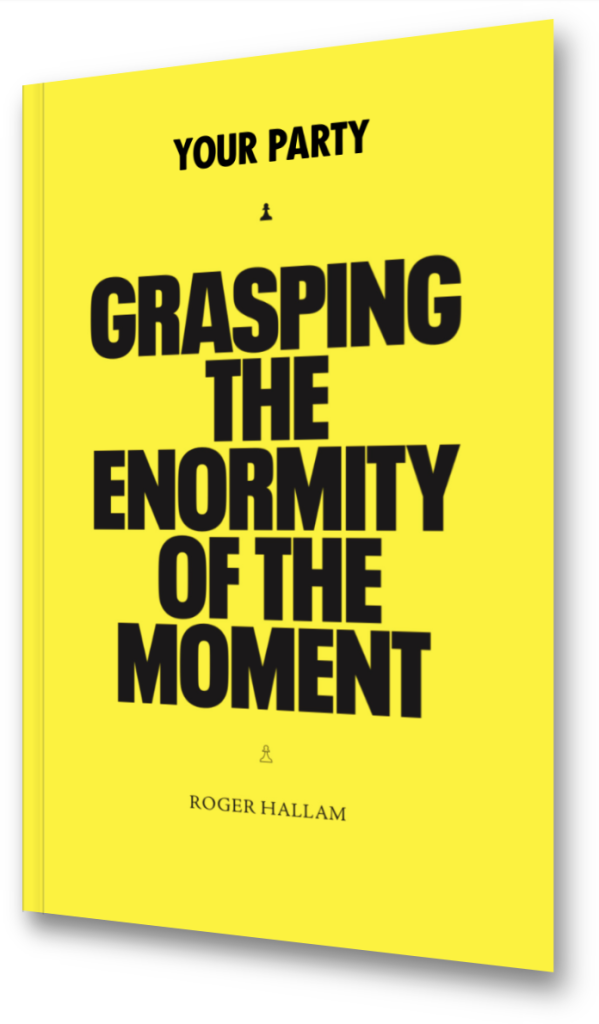
If you liked this article, consider grabbing my latest book, Grasping The Enormity of the Moment, on organising political power in the wake of the Your Party surge.

If you want to get involved, sign up for a training Zoom call with Assemble.