🎸 We're Pretending It's Just Rock and Roll
Chatting with Mr Fish on prison, quantum physics, the death of materialism, and why 2034 will make the 1960s look like a warm-up.
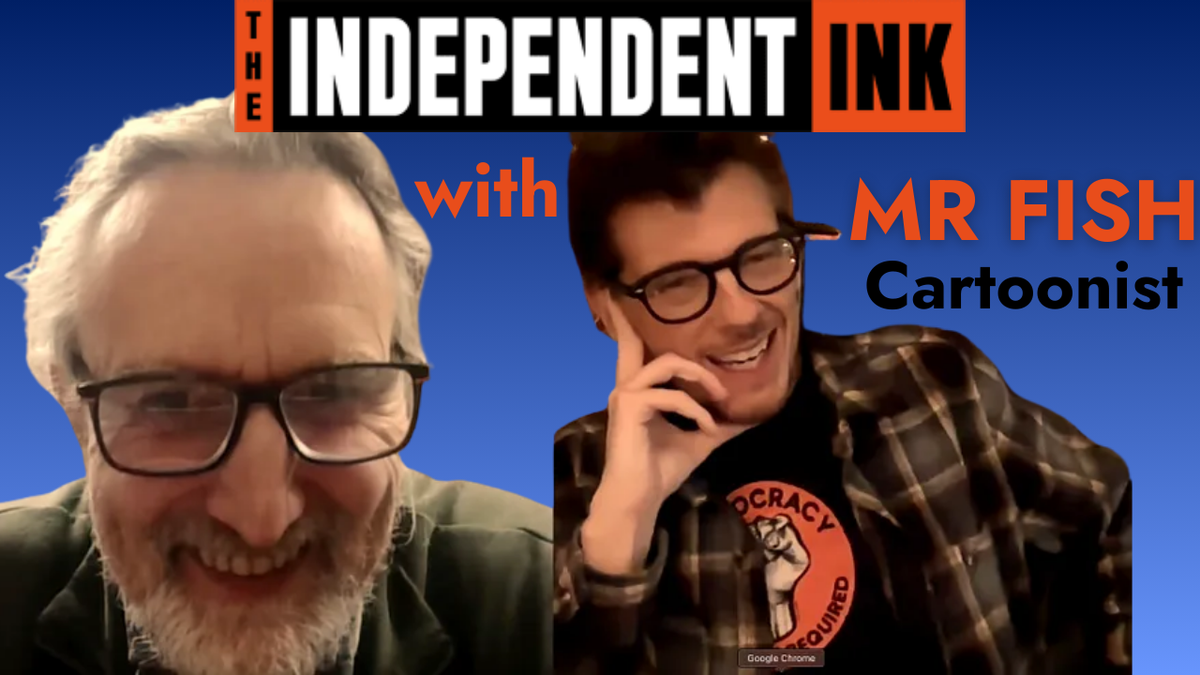
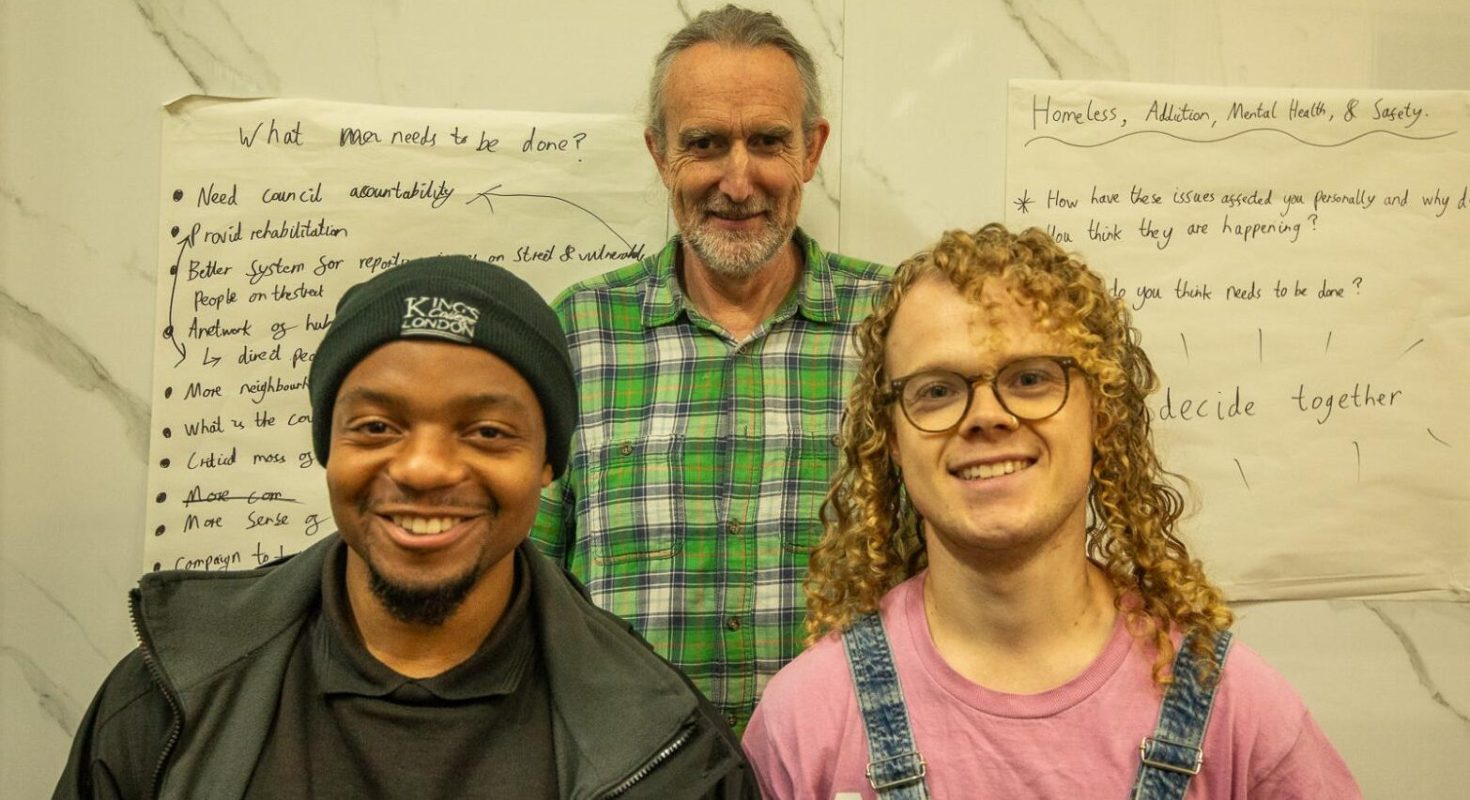
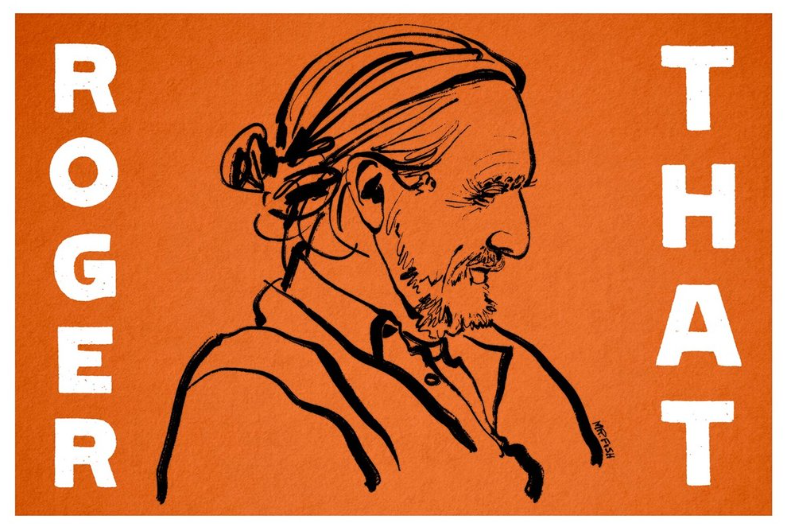
Dwayne Booth, aka Mr Fish, is a renowned political cartoonist and a frequent collaborator with my friend Chris Hedges. I was honoured to be invited on for an episode of his podcast, The Independent Ink to discuss the horrrific posibility of 4 Billion Dead. You can listen and watch on Dwayne's Substack or read as a condensed transcript below.
 Mr. Fish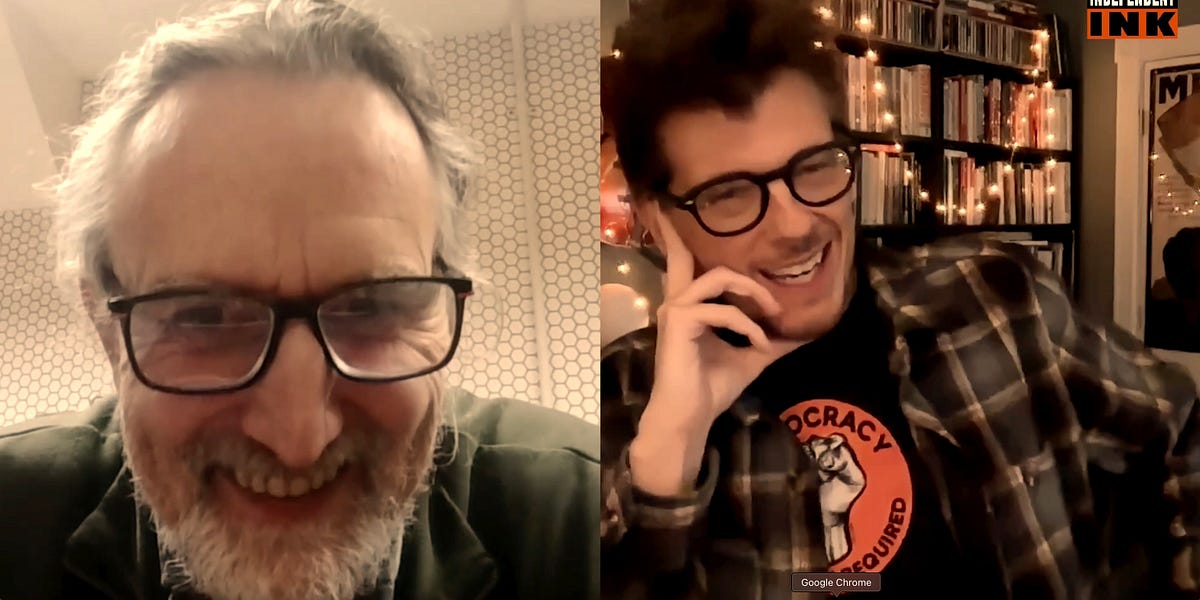
Mr Fish: Roger, I really appreciate you taking the time. I know how busy you are — and with very good reason, given the urgency of what you're working on. Let's start simply: you recently spent time in prison. Can you walk us through the circumstances?
Roger Hallam: Yes — and thanks very much for having me. So, the court case was in July 2024. It related to a series of actions roughly two years prior, involving people climbing onto bridges over motorways to make the point that we need to slash carbon emissions. There was a large action — about a hundred people stopping traffic across several bridges.
For the record, I wasn't involved. But I was brought in, as I tend to be, to give a speech — to rally people to the urgency of the situation.
Mr Fish: And you're a known quantity for this kind of activity, which makes you both an asset to a movement and a target for those who want to shut it down.
RH: Exactly. This has been my bread and butter for decades. Inviting someone to speak at a civil disobedience action — to say, "Yes, this is what the situation demands" — was entirely normal in the UK and across the western world. But as you and your listeners may be aware, there have been increasingly draconian laws passed in the UK in recent years.
What happened was that a journalist from The Sun — a right-wing tabloid — was present at the event. She recorded my speech and gave it to the police. They came to arrest me while she intended to film the whole thing. I happened to be out when they arrived.
I didn't think much of it at first. I've done dozens of these talks; I assumed I'd be out the following morning. But I was put on remand — held in prison for four months before they finally released me on a tag. Then, a year and a half later, there was a full trial. We received four to five years for conspiracy to cause a public nuisance — which is the quaint English phrase for what the actual bad guys are doing, of course.
It was the longest sentence handed down for peaceful civil disobedience since, I don't know, the Napoleonic Wars or thereabouts. Even the Suffragettes were getting two or three years. Once you're past five, it usually means you've killed someone. I hasten to add that all I did was a twenty-minute Zoom call. So it's really a sign of the times. I appealed and was released on licence last August.
Mr Fish: The vagueness of the charge is striking. "Causing a public nuisance" — it's the same logic used historically against civil rights protesters. Black students sitting at lunch counters could be framed as bad for business. The Little Rock Nine were said to be a "deterrent to education." The charge is always the disruption, never the injustice being protested. What does it signal to society when the state reaches for these tools?
RH: The simple answer is that the state operates on what you might call Hobbesian logic. Thomas Hobbes is the political philosopher of the secular state — the idea being that the state is supreme, that it exists to prevent disruption and disorder, and that it is justified in doing whatever is necessary to that end. If the state collapses, you have anarchy. That's been the logic of the establishment for the past three or four hundred years in western societies.
What I'd push back on, though — and I've written about this in Suicide — is that our actions were actually compatible with Hobbesian logic, properly understood. There is a well-known exception in political philosophy: when the people running the state are themselves destroying the state. Historically, this has meant treasonous activity, spying for foreign powers, that sort of thing. It's a rare exception — arguably the last time it clearly applied in Britain was three or four centuries ago.
But the people running the state today are objectively destroying it. There is a substantial probability — arguably an inevitability — that climate disruption will destroy the British Isles within the next fifty years. Changing ocean currents, catastrophic weather systems — this isn't a matter of opinion. It's a non-trivial, well-evidenced possibility. So the Hobbesian argument collapses in on itself: the more of a Hobbesian you are, the more you should support resistance to the state's current agents.
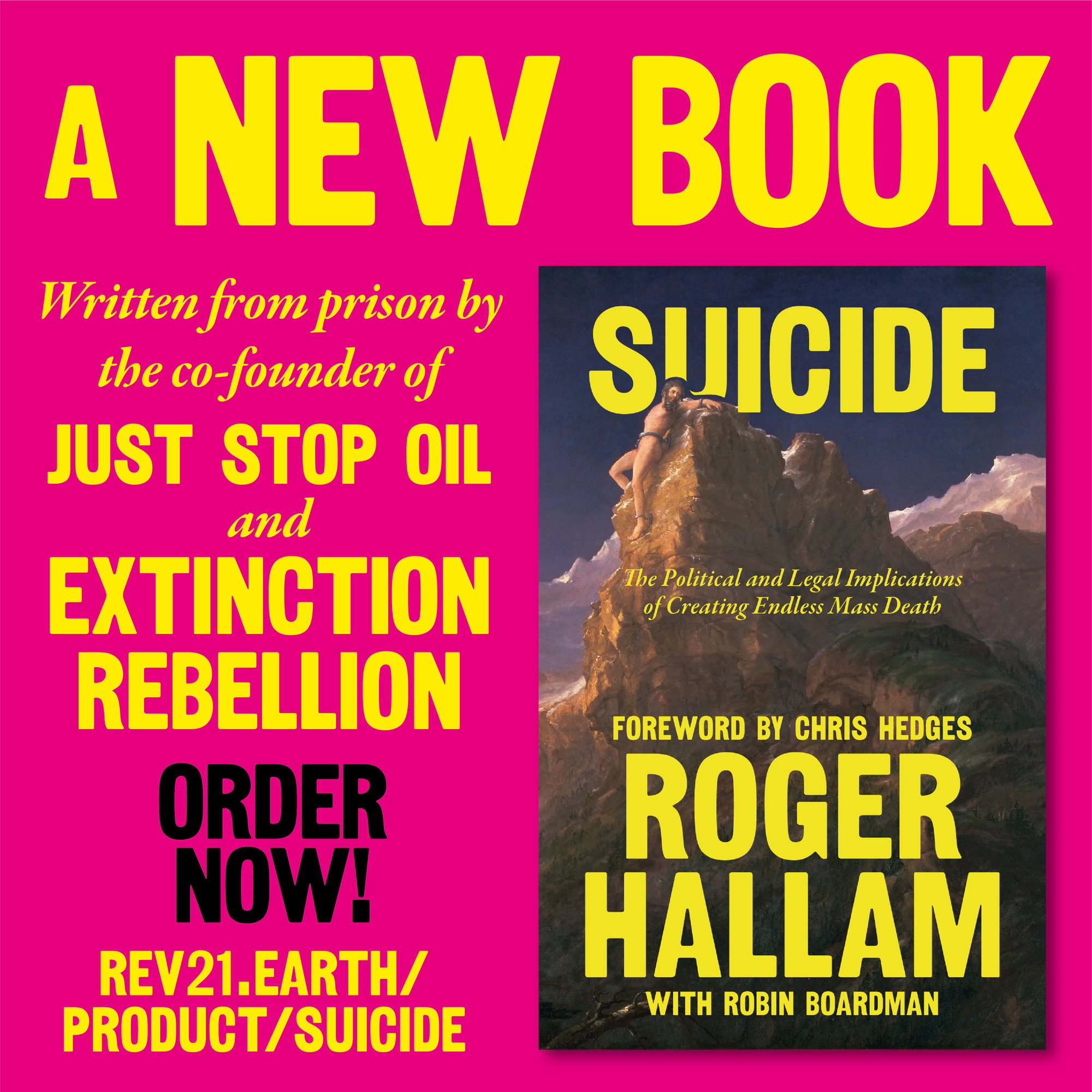
What I tried to argue in court — to the judge's considerable discomfort — was that if you send to prison people who are trying to save the state from those who are destroying it, you are, in the classical definition, a traitor. He wasn't having any of it, of course. And the lawyers were right in a pragmatic sense — it wasn't going to work. But I'm not interested in pragmatics. I'm interested in the truth. Which is why we refused to be quiet. If you take an oath before God to tell the whole truth, you are spiritually and morally obliged to do so. Every time he told me to sit down, I said, with all due respect, God outranks you, Your Honour — and carried on. He left the courtroom several times. The police were dragging us out every few minutes. It was, in its way, a bit of a comedy — an English version of the Chicago Seven.
Mr Fish: You confound people by saying you don't mind prison. That there's a kind of agency that the locked door can't touch. Can you say more about that?
RH: Well, let me say first that I don't tend to follow the usual interview format on the left, which is to bash the bad guys for half an hour. I'm not that interested in the bad guys. Evil exists — it always has. What makes evil a problem isn't its existence but people's complicity with it. So the more interesting question is: why do people go along with it? Why do they delude themselves?
The first problem is that people on the left don't want to accept what we're actually dealing with. They think: vote in the right people, pass the right legislation, sort out the climate issue. But this isn't a climate issue to be managed through policy. It is a Universal Death Project. It will continue, objectively, indefinitely, because it is science. So we're not heading towards reform. We're heading towards revolution.
The second problem is the deeper one. People are stuck in a modernist, materialist, reductive framework — one that came out of the Enlightenment and that has justified the extractivist logic destroying the world. Everything is dead matter, moving like billiard balls according to Newtonian physics. But that picture was demolished by Einstein in 1905 and by quantum mechanics thereafter. Science now tells us we're living in a quantum universe — that there is universal consciousness, that time and space are provisional constructs, that what the ancient mystics and most religious traditions have said throughout human history turns out, empirically, to be right.
And when you genuinely internalise that — not as a slogan but as a lived reality — then prison doesn't exist in the way people think it does. What exists is your consciousness and your will. I've been to prison six or seven times. By now, if the police walked through that door and took me away for twenty years, I'd probably be annoyed for about three days. Not because I'm some alien saint — I'm not. I'm a regular rebel. But because I've done enough training, internal and external, to know that the cell is not the limit of what I am.
Mr Fish: That word — training — feels crucial here. This isn't passivity or detachment. It's something active.
RH: Precisely. This is what almost everyone misses about the non-violence tradition. Non-violence isn't a tactic you adopt because someone told you it works strategically. The output is non-violence; the input is preparation. Training. There are two thousand years of history on how people get themselves into a position where they are genuinely detached from the consequences of oppression — meditation, role-playing, testimony, ritual.
I read a book in prison about the early Christians. Every so often, the Romans would round up a group and crucify them near Lyon or wherever. When a few from one group fled before their execution, the ones being crucified were reported to have said something along the lines of: "Those men didn't train properly." That's not about being a saint. That's about systematic preparation.
The failure of modern civil resistance movements is that they think non-violence is a supermarket choice — like picking apples instead of oranges. "We'll be non-violent because that's the winning strategy." And then it's hard and unglamorous, and people think: maybe we should try violence instead. It's completely superficial. If you look at the literature, successful civil resistance — Solidarity in Poland, the Salt March, the monks in Burma — always has a cultural-religious basis. Not necessarily Catholic or Christian, but some mechanism of collective transcendence. Religious people sustain the struggle longer not because of their funny clothes but because they have two thousand years of accumulated wisdom about what it means to live rightly in the face of suffering.
Mr Fish: Which brings us to the new project. Tell us about 4 Billion Dead.
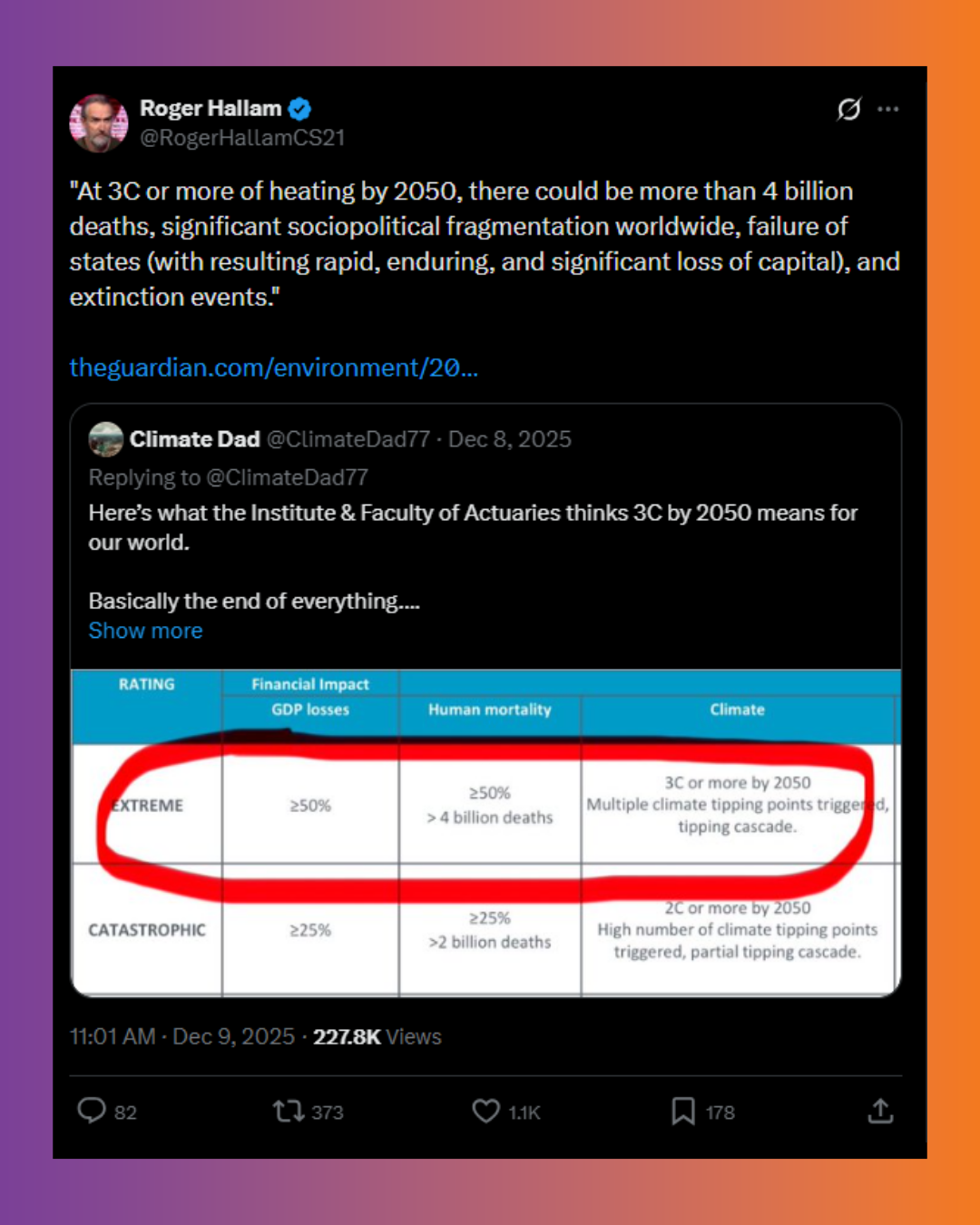
RH: The name comes from a report by the British insurance industry — and I'd note that if anyone understands numbers, it's the insurance industry. The report found that carbon emissions sufficient to push global temperatures past two degrees will likely kill two billion people; past three degrees, four billion. In a spectacular act of English repression, the industry buried this information in an appendix. When the Guardian covered it, the headline was about projected GDP loss. You had to read to paragraph five to find the mention of four billion deaths. If you needed any evidence that liberal media has been thoroughly colonised by capitalist logic, there it is.
So: four billion deaths. The project is not primarily about talking about that number — because the very act of trying to discuss it rationally is, in a sense, an obscenity. It's a spiritual catastrophe. What the project does instead is ritual. People will hold up a sign reading "4 Billion Dead," photograph themselves, and share it — with no accompanying petition, no call for a government act, no liberal framing that would shrink the enormity of it back down to something manageable.
The vision I have is of marches — organised, disciplined, silent. Not western-individualist "let's go on a demo." Think of the civil rights marchers in their suits, five metres apart, holding their signs with military precision. Gandhi did the same. That's what we want: a hundred people walking in silence through a western city, each holding a sign, each handing out a photocopied page of that actuarial appendix.
The purpose is to build a collective psyche — to take people out of their individualist, rationalist selves through shared ritual and collective action. It is, in essence, training. Training for what's coming.
Mr Fish: And what is coming?
Roger Hallam: In the 2030s, you will have a generation of young people who are twenty or twenty-five and who understand — viscerally, not theoretically — that their parents' generation destroyed the world. Think of the generation in 1960s Germany who discovered what their parents had done, and multiply it by a hundred. Because the Nazis destroyed six million people. Our generation is on track to destroy four billion — and the world's ecosystems along with them. They are not going to be happy.
Here's an analogy from American cultural history. In 1956, there were the Beat poets — Jack Kerouac, Ginsberg, a handful of others. Nobody cared. Everyone thought they were odd. Then in 1962, a whole generation decided that the post-war settlement — nuclear madness, reductive materialism, the world their parents had built — was not for them. And suddenly Kerouac had ten million readers. We've all read On the Road. It's not actually that good, but you know what I mean.
We are currently in 1956. We have Elvis — we're pretending it's just rock and roll. But in about 2034 we hit the psychedelics. With one difference: this time, it won't be individualism. The 1960s was individualist — do your own thing, find your own enlightenment. What's coming will be collectivist. People won't have the luxury of individualism in 2034 the way they did in 1972. It will be variations on collectivism — community, solidarity, shared sacrifice.
The process I describe might sound like nonsense to half the people listening. Fine. But as day follows night, this is what's coming.
Mr Fish: That feels like a beautiful way to close. We're going to learn how to get out of our own way — and when we do, we start inviting participation from the universe and from each other. I hope we're not murdered before it happens.
RH: Death is not the end, remember. Don't panic!
And look — I want to be clear. I'm pointing towards something, not claiming to have arrived at it. Being close to God is not being God. I have nervous breakdowns like everyone else. It's a lifelong process of moving — imperfectly, stumblingly — away from being a slave to material conditions. That's all I'm talking about.
My last word: go on a training weekend. Don't sit in your individualist head deciding whether or not you believe all this. Put yourself in a room with other people, do the work together, and let yourself find out who you are in community. That's the click. Not intellectual masturbation — training weekends, where you do A, B, C and D and find yourself inside some form of community of resistance. You do it again. And again. And at a certain point, you become competent enough to help build what comes after capitalism.
Mr Fish: Let's make that culture happen. Roger, thank you so much.
RH: Thank you for having me. Best of luck, everyone.

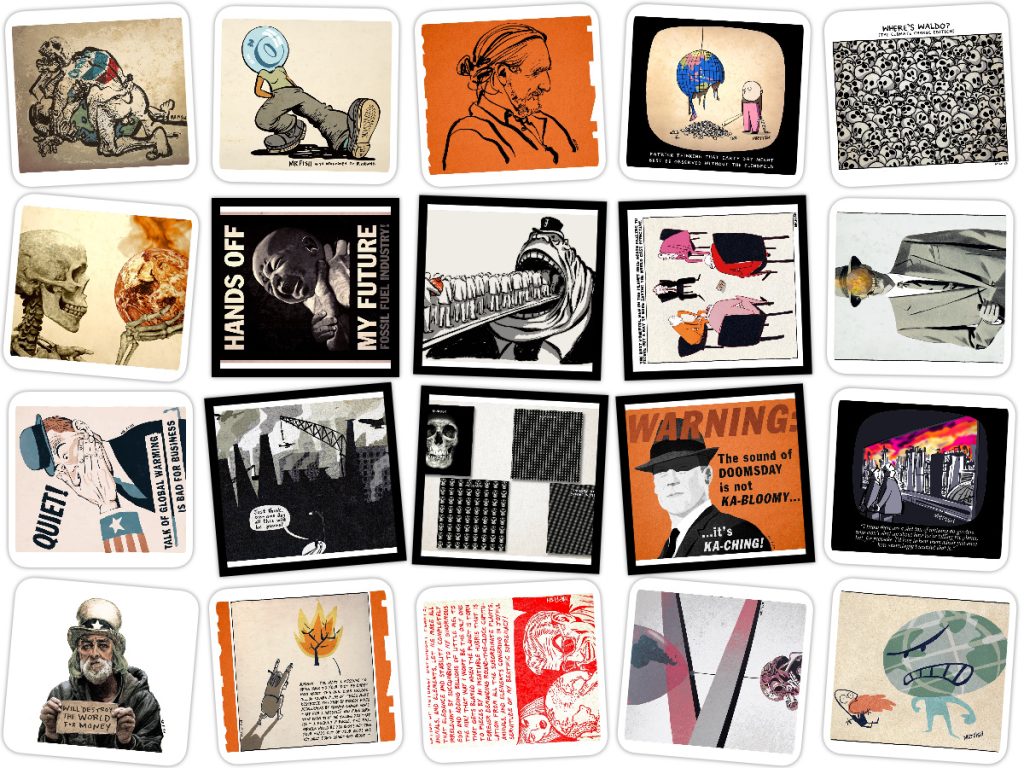
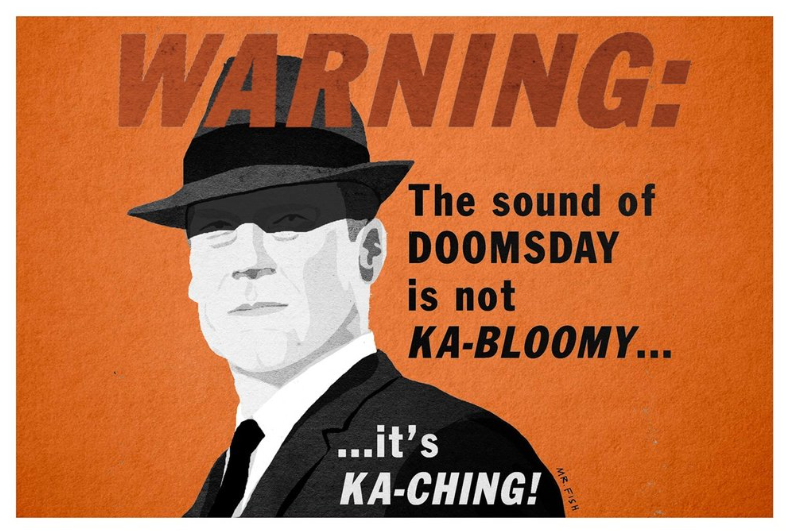
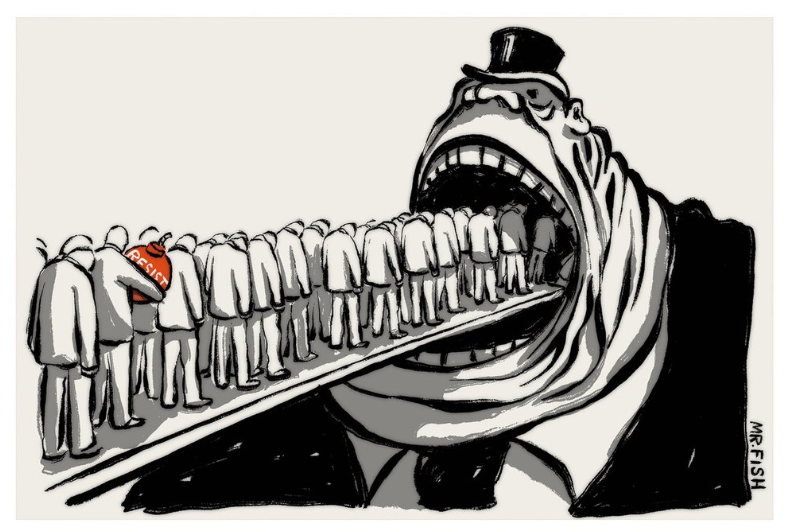
If you enjoyed this interview, please also check out the Twenty Rev21 postcards designed by Mr Fish on the Rev21 shop. He made them to help fundraise for me while I was in prison. With his usual gallows humour, Mr Fish paints a darkly accurate picture of our bizarre times.