The All-System Iterative Approach (ASIP): Analysing Climate Collapse and Its Human Consequences
Billions will die as civilisation collapses — this report explains why, and how we plan to measure it in real time.

This report originates from my viral blog published on March 21, 2025 entitled: "Why the Human Race is Going Extinct this Century," which was also explained in a video/podcast recorded from my prison cell: "We're Going Extinct"
I will then provide references to recent scientific reports that support why an open-source citizens model, using ASIP methodology, is needed: traditional models under-report temperature increases; billions of lives are at risk because we face ecological and civilisation collapse, and extinction in this century.
At the time, I proposed the following:
"I would like readers to get in touch to be involved in creating an open-source citizens model, using this methodology to develop real-time analysis, as new data is produced. This would create a public alternative to the discredited models and 'mainstream science' subject to dysfunctional methodologies and political capture. This new approach can inform the new progressive forces which will be needed to guide policy as existing political regimes collapse as conditions exponentially worsen. One more prediction is effectively inevitable, and that is that political revolutions will occur in the next decade as the horrors we face become plain for citizens to see."
After my release, I worked with activists from 4 Billion Dead to prepare this introductory report explaining the All-System Iterative Approach (ASIP), a non-linear and conservative methodology for analysing, on a decadal basis, both temperature increases and the human and ecological consequences. I will begin by explaining the methodology and how we plan to establish an ASIP analysis project in the months ahead. I will then provide references to recent scientific reports that support why an open-source citizens model, using ASIP methodology, is needed: traditional models under-report temperature increases; billions of lives are at risk because we face ecological and civilisation collapse, and extinction in this century.
As explained below, ASIP will provide two forms of analysis, Climate Science and Social (Mass Death) Science.
Analysis 1 (Climate Science): ASIP — Consideration of All Relevant Factors and the Analysis of Climate System Development
Methodology
It is formally impossible to predict any future event with absolute certainty. It is possible that, due to geoengineering and other technological developments, we may reverse global heating. However, it is questionable whether this technology exists, and, if it does, whether it can be deployed at scale within the available time, given its enormous costs and the need for international cooperation, all of which must be implemented in the context of widespread social collapse. Tipping points in the Earth's system have now been triggered due to the present level of human-created emissions and locked-in additional inputs of carbon lag and air pollution. The possibility of human extinction by the end of the century is now the main scenario, and what is certain is that a level of social disruption more significant than any other period in human history is now locked in.
The All-System Iterative Approach (ASIP): A Non-Linear and Conservative Form of Analysis
Mainstream climate science has an increasingly poor record of making accurate predictions because it is embedded in a dysfunctional paradigm. This failure reached crisis levels in 2024 due to the inability to predict or explain a sustained underlying jump of 0.2°C in global temperatures. Some conventional methodologies analyse only one factor of the system and base their findings on that single process. However, no one process is independent of the other parts of the system. Other methodologies assume linear rather than non-linear change, an approach that may have made sense in the past when all parts of the system were not linked, but that is no longer the case. The rate of change now proceeds at an exponential pace; therefore, the ratio of change between 2°C and 3°C will be different from the rate of change between 1°C and 2 °C. Traditional long-term projections assume that prolonged planetary overheating will have a gradual impact on human civilisation. The science of complex systems holds the opposite; an initial decline will lead to sudden systemic collapse. These facts must be taken into consideration when projecting the consequences of planetary overheating for human civilisation.
There is now only one system: the all-Earth system. To understand any part of the system, it is necessary to look at the whole. Only an all-system analysis can make accurate predictions. The correct analysis requires three fundamental elements. First, the consideration of all relevant factors, including forest fires, permafrost melt, loss of carbon sinks, the albedo effect of ice cover loss, and the impacts of tipping point activation. Second, an analysis of climate system development, how, over time, the factors interrelate in terms of the feedback processes which affect various parts of the system. Third, accurate and informative projections about the ecological disasters and loss of human life caused by sustained non-linear temperature increases across the globe.
Many scientists also fundamentally misunderstand the social context of their research. The traditional approach is rooted in a culture that focuses on research matters that involve no risk to human beings. The purpose, then, is to establish the certainty of a hypothesis, an approach that requires a high level of supporting evidence to provide 'proof.' However, there is an opposite set of circumstances, namely, where human lives are at risk. In this situation, what would be called a conservative approach has the opposite logic to that when no lives are at risk.
While conventional climate science methodologies are rooted in a culture that focuses on research that poses no risk to human beings, that's not the case with planetary overheating. An analysis of the danger of climate change to human life requires what I call a "conservative" approach, which means a realist approach, which must take account of low probabilities. The precautionary principle applies, encouraging preventive action in the face of uncertainty, especially when the potential for harm is high. In other words, a "better safe than sorry" approach. Concerning planetary overheating and its impact on life on Earth, logic dictates that one considers not just the likelihood of an outcome, but also the cost of failing to have prepared adequately for it should it occur. Regarding worldwide ecological overshoot and the resulting global overheating, the cost will be extraordinarily high, and the failure to act decisively in an emergency will be catastrophic, especially when the possibility of irreversible and cataclysmic harm, including extinction, exists.
4 Billion Dead
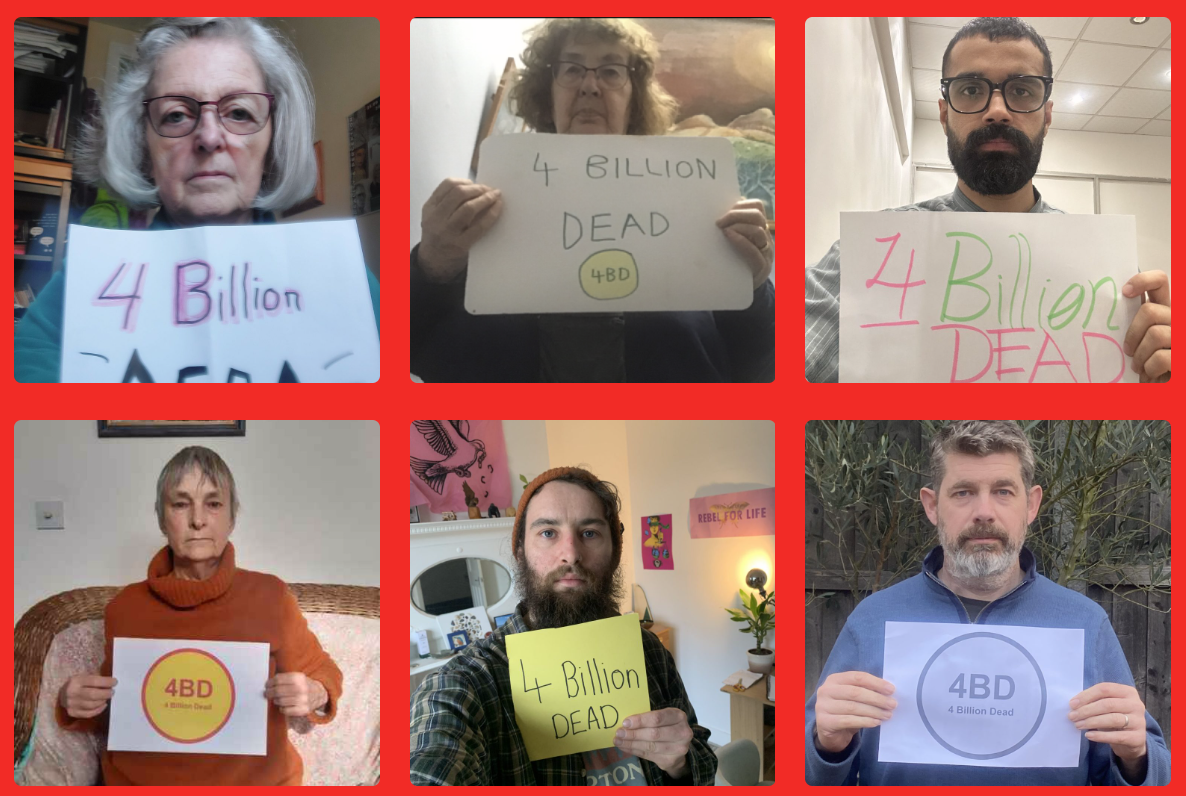
To provide the public with the truth about climate collapse, including the human and ecological consequences, we have established a new campaign: "4 Billion Dead" (4BD). Citizen activists will bring scientists, actuaries, insurance experts, and mass-death analysts together to inform the public about the true state of global overheating and its ecological and human consequences through regular, comprehensive, and understandable reports and online presentations. Extreme suffering is coming down the line, and regime collapse and mass death in the billions is virtually certain without the kind of emergency action that existing governments have been institutionally incapable of delivering. We need to anticipate and plan for worst-case scenarios as a basic matter of precaution.
Implementation Process for the 4BD Climate Science Analysis
ASIP Roll Out
4 Billion Dead will implement the ASIP real-time analysis in early 2026, a public alternative to the discredited models and to mainstream science, which is subject to dysfunctional methodologies and political capture.
4BD volunteers will activate ASIP with the assistance of scientists. The program will analyse all relevant factors that influence temperature increase, including CO2 concentration, temperature, Arctic and Antarctic sea ice, ocean heat content, extreme weather events, forest fires and their impact on carbon sinks, permafrost melt, albedo effect of loss of ice cover, as well as the impacts of tipping point activation. The all-systems form of analysis is critical because many existing models do not consider all relevant factors, including those that will assume greater importance as collapse intensifies.
For example, mainstream reports do not formulate temperature projections that account for the impact of tipping points. Instead, they usually limit discussion to assessments about the probability of tipping points. The actual state of collapse is far past that. It calls for temperature projection assessments, as difficult as they may be, for both tipping points that are already activated and those that will soon be activated because they can no longer be prevented. For example, the most recent and accurate data on the Atlantic Meridional Overturning Circulation (AMOC) indicate that its tipping point will be reached before 2050, perhaps earlier (Rahmstorf, page 11). Although AMOC activation does not mean immediate and full collapse, it's certainly the beginning. The precautionary principle requires at least good-faith attempts to measure the post-tipping-point consequences for the overall climate system's development following the date of tipping-point activation.
Reports and online presentations will be utilised to inform the public about up-to-date findings from leading non-reticent climate scientists and how, over time, different factors affect other climate system factors. Understandable explanations will be provided about the human consequences. Regional consequences will be emphasised, and an extensive online library of climate science reports will be created, focused on the important work of non-reticent climate scientists.
Erroneous assumptions used by captured organisations in their discredited models will also be explained and corrected. For example, the IPCC projects 3°C of temperature rise for doubled CO2 above preindustrial levels. Climate sensitivity, however, is substantially higher than IPCC estimates. More accurately, we should anticipate a 4.8°C temperature rise (ranging from 3.6°C to 6°C) with the doubling of CO2. (Hansen, pages 7–8). This fundamental error distorts all IPCC temperature projections, suppresses public awareness, and blinds decision-makers to the real existential level of risk.
Accurate projections are not possible without a sound foundation. An accurate baseline for measuring temperature increases will be clarified in 4BD presentations. Using an accurate baseline is especially important because politicians offer misleading assurances such as "in ten years our government will reduce the CO2 level to 1995 levels," distortions dutifully reported by the mainstream media. But 1995 is not the baseline for measuring warming. Truthful reporting calls for the correct baseline that considers the latest evidence. See, for example, this CNN report on data that raises questions about how much the Earth has warmed.
 Chris Mooney
To accurately assess all factors that impact global heating, it will be helpful to provide increased transparency, in understandable language, about the internal workings of certain factors. For example, Carbon Sinks Efficiency measures how well natural systems absorb and store atmospheric CO2. Often, a single overall finding is presented based on data from 3 different carbon sink elements: forests, oceans, and soils. Given the dramatic increase in forest fires and the increasing acidification of the oceans, the public needs to understand how the interplay among these factors affects the overall findings. ASIP will explain the specific impacts of the various elements, how they affect one another, and their overall impact on the system.
How ASIP Findings Differ from Mainstream Findings
ASIP findings will be presented in a manner that encourages mass mobilisation and informs citizen assemblies; they will be public and activist-oriented rather than other-scientist-oriented. They will be accessible through written and online presentations that use accurate, understandable language rather than technical jargon and coded references.
Underlying data and findings will consist of credible, verifiable sources, such as NASA, NOAA, Copernicus, Berkeley Labs, the Potsdam Institute, the Global Carbon Project, and reports by non-reticent climate scientists. Links to source data and report findings will be provided. However, the deliberately neutral tone used by mainstream science will be strictly avoided. Emotional engagement is an essential ASIP component. As I stated in a recent post:
"Liberal culture cannot say the word 'death,' even as billions face it. Euphemism has become a form of violence — and the first step to resisting collapse is naming reality without flinching . . . stuck in liberal euphemism, self-censorship, and the relentless softening of truth."
If we do not tell people "what this means for you", we are not telling the full truth.
Findings will be evaluated and presented using precautionary principle risk framing. Given the level of harm faced by all humanity and the onslaught of misinformation produced by well-funded corporate falsehood sources, ASIP findings must emphasise the truth about accelerating collapse and worsening trends.
Presentation and Education
ASIP educational talks and documents will be presented in as simple a manner as possible, to be easily understood by non-scientists. They will be jargon-free, emphasise "what this means to you," and include explicit precautionary risk framing. A short explanation of specific metrics will be provided. Given the facts, there will be an emphasis on non-linear acceleration and worsening. If appropriate, historical perspectives will also be provided.
ASIP presentations and projections will also differ from mainstream information because of the consistent use of decadal projections. Decadal projections are essential to the challenge of moving the Overton Window to where the possibility of human extinction in this century becomes the framework for effective mass mobilisation and citizen assembly-formulated demands.
Project Implementation
4 Billion Dead is an active Rev21 Science Team project with a formalised and documented structure, organisation charts, document libraries, a document management system, and active public recruitment meetings.
The 4BD website will open to the public in January 2026. Six sub-teams are staffed and operational: Core Team, Outreach Team, Science Education Team, Science Liaison Team, Website/Social Media Team, and Tech Team.
The ASP roll-out will be organised and managed by 4BD's Science Education and Science Liaison Teams, with significant participation from the Website/Social Media and Outreach Teams. Weekly planning/implementation meetings begin January 2026, including the creation of a project organisation structure, goals, roles and responsibilities, timeline, public communication plan, budget, etc. ASIP online presentations and workshops will begin at the Rev21 May 2026 Festival.

3°C Above Pre-Industrial by 2050: Recent Scientific Findings
Recent findings from some of the world's finest climate scientists support the primary projection raised in the March 21, 2025, blog: the Earth will reach 3°C above Pre-industrial by 2050. These findings are presented by date, oldest first.
1. Estimated Heating at the Doubling of CO2
Oxford Open Climate Change, Volume 3, Issue 1, 2023 — James E. Hansen et al. (August 6, 2025)
Based on historical records (ice; ocean and lake sediment; bore holes into the earth's crust; and cave deposits), when CO2 levels double, the Earth's temperature rises an average of 4.8°C (ranging from 3.6°C to 6°C).
The connection between increases in CO2 levels and temperature increases is stronger than IPCC projections indicate. ("Climate sensitivity is substantially higher than IPCC's best estimate (3°C for doubled CO2), a conclusion we reach with greater than 99 percent confidence.") "Seeing the Forest for the Trees," James E. Hansen and Pushker Kharecha, August 6, 2025. The Intergovernmental Panel on Climate Change (IPCC) currently estimates temperature increases of 3.0°C for doubled CO2. Dr. Hansen points out that the IPCC's best estimate of 3.0°C is inconsistent with multiple lines of scientific evidence. The "greater than 99 percent confidence" is based on an analysis of multiple and combined data sets and concludes that the probability of climate sensitivity being as low as 3.0°C or less is extremely small.
These findings refute a fundamental IPCC projection, demonstrating that the risk of a much hotter future is significantly greater than conventional models estimate. Furthermore, the decadal rate of CO2 increase is increasing exponentially rather than linearly.
The CO2 level in 1750 was 280 parts per million (ppm). In May 2025, the CO2 level at Mauna Loa Observatory reached a high point of 428 ppm. The average annual increase of atmospheric CO2 by decade was as follows:
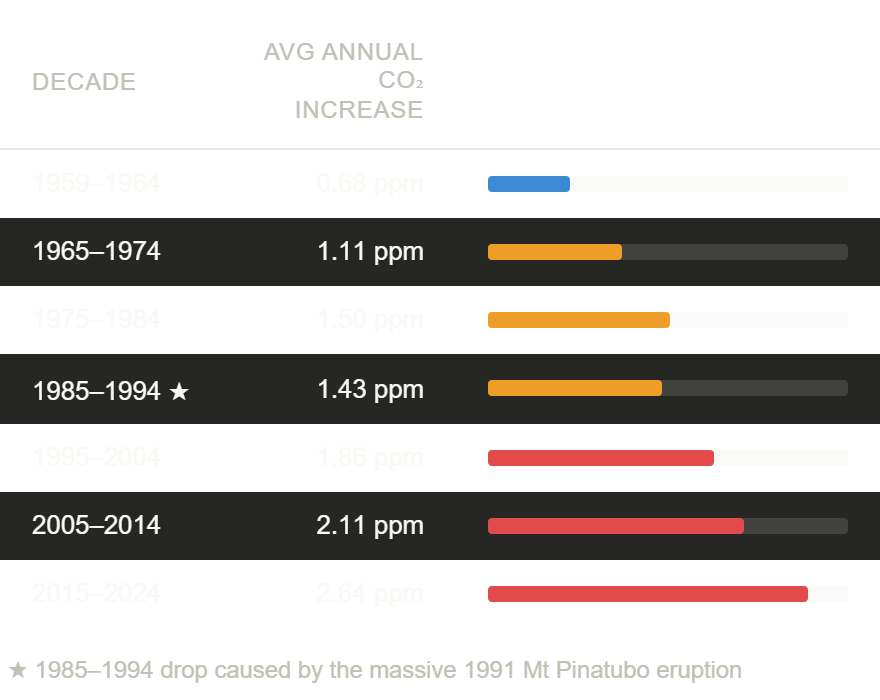
The 2023 to 2024 increase in atmospheric CO2 was 3.54 ppm. Assuming future annual CO2 ppm increases do not exceed the 2023–2024 increase, the Pre-Industrial level of 280 ppm will double in 37.7 years (2062), baking-in temperature increases of approximately 4.8°C (ranging from 3.6°C to 6°C).
However, doubling may take place before 2062 for at least two reasons. First, the sixty-year trend demonstrates that annual ppm increases have steadily increased, and more so for the past 30 years. Second, certain man-made gases did not exist in the measured historical periods. Other gases, such as methane, did exist, but at significantly lower pre-industrial levels. Post-industrial levels of gases like methane affect the temperature rise. While the level of impact requires further study, from a conservative, precautionary perspective, the effects of man-made gases, in combination with CO2, must be considered when projecting temperature rise.
2. Report from the German Meteorological Society (DMG) & German Physical Society (DPG)
dpg-physik.de (September 21, 2025)
Some Key Takeaways (translated from German by Google Gemini):
- "It can no longer be denied: climate change is progressing unchecked and is accelerating. In 2023 and 2024, the global average temperatures were 1.5 degrees Celsius above pre-industrial levels for the first time. It is even possible that the 1.5-degree limit for global warming, decided upon in Paris, may already have been permanently exceeded."
- "Meanwhile, even the commitment to keep global warming well below 2 degrees Celsius can only be achieved with significantly increased efforts by the international community, and there is a growing risk that this target will be missed. Global warming has entered an acceleration phase. As early as 2050, warming could even reach 3 degrees Celsius above the pre-industrial era, with the temperature increase in Germany being significantly higher than the global average. Results from climate models indicate that warming up to 5 degrees Celsius is likely by the end of the century. This can only be prevented by humanity changing its course."
3. Oxford Academic / BioScience: The 2025 State of the Climate Report
A Planet on the Brink — Potsdam Institute & Oregon State University (October 29, 2025)
Some Key Takeaways:
- Currently, 22 of 34 planetary vital signs are at record levels.
- Warming may be accelerating, likely driven by reduced aerosol cooling, strong cloud feedbacks, and a darkening planet.
- The human enterprise is driving ecological overshoot. Population, livestock, meat consumption, and gross domestic product are all at record highs, with an additional approximately 1.3 million humans and 0.5 million ruminants added weekly.
- So far, in 2025, Greenland and Antarctic ice mass are at record lows. The Greenland and West Antarctic ice sheets may be passing tipping points, potentially committing the planet to meters of sea-level rise.
- The Atlantic meridional overturning circulation is weakening, threatening major climate disruptions.
4. David Spratt: The Worst Outcome of Systematic Collapse; Cascading Climate Tipping Points
Climate Emergency (video), October 31, 2025
Some Key Takeaways:
- The IPCC's midrange projections underplayed accelerants (like aerosol cleanup and nonlinear tipping dynamics). We're not "approaching" 1.5°C — we're effectively already there, and the comforting 20-year averages are a storytelling trick that makes the emergency look smaller than it is.
- The global climate system has reached a state of "nonlinear" collapse, where irreversible tipping points for the Arctic, West Antarctica, and the Amazon are likely already behind us, locking in future sea-level rise and ecological breakdown regardless of current actions.
- Meanwhile the political class remains mired in a "cognitive disjunction." "Net zero by 2050" functions like a high-class indulgence sale: keep burning, promise offsets later, and call it responsibility.
- This emergency poses a direct threat of civilizational collapse by 2050, as the combination of extreme heat, 30% crop yield failures, and the salination of vital river deltas renders vast regions of Asia and Africa uninhabitable and triggers mass state failure. At three degrees, it's no longer about saving nature; it is about whether complex human societies remain governable, feedable, and coherent at all.
5. Dr. James E. Hansen — The Truth About Global Warming, ATLAS25
YouTube, November 21, 2025
Some Key Takeaways:
- Warming is already here and accelerating, with Earth measurably out of energy balance: "We do not need to wait ten years to conclude that we have reached 1.5 degrees global warming."
- Institutional caution and delay are actively harmful: "Scientific reticence is dangerous in a problem that has delayed response."
- The IPCC's central estimate understates how responsive the climate is to CO2: "Climate sensitivity is probably between four and five degrees Celsius for doubled CO2 rather than three."
- The 1.5°C-by-net-zero-2050 storyline is physically unrealistic: "What hogwash."
- The failure to pursue nuclear alongside renewables is an advisory and policy breakdown: "What good are advisors who do not advise?"
6. Prof. Stefan Rahmstorf — Our Heating System is Heading for Shutdown, ATLAS25
YouTube, November 21, 2025
Prof. Stefan Rahmstorf, Professor of Physics of the Oceans at Potsdam University:
"The most reliable findings demonstrate that the tipping point for an AMOC shutdown will occur before 2050, the AMOC tipping point where the shutdown becomes inevitable is probably in the next 10 to 20 years or so, and thereafter we are past the point of no return and shut down is inevitable." (15-minute video at 12:42)
7. Warning! This "Colorful Chart" is Censored by IPCC — Dr. James Hansen
columbia.edu, November 21, 2025
Abstract: The growth rate of greenhouse gas (GHG) climate forcing increased rapidly in the last 15 years to about 0.5 W/m² per decade, as shown by the "colorful chart" for GHG climate forcing that we have been publishing for 25 years (Fig. 1). The chart is not in IPCC reports, perhaps because it reveals inconvenient facts. Although growth of GHG climate forcing declined rapidly after the 1987 Montreal Protocol, other opportunities to decrease climate forcing were missed. If policymakers do not appreciate the significance of present data on changing climate forcings, we scientists must share the blame.
8. Global Temperature Record of +1.7°C in 2027 — James Hansen, Pushker Kharecha, Dylan Morgan and Jasen Vest
jimehansen.substack.com, December 18, 2025
Some Key Takeaways:
- The 1.5°C Barrier Has Been Breached: The average global temperature for the three-year period of 2023–2025 has reached +1.5°C relative to the 1880–1920 base period.
- 2025 is the Second Hottest Year on Record: While slightly cooler than the freakishly hot 2024, 2025 clocked in at +1.47°C.
- New record in 2027: 2027 will shatter records, reaching a staggering +1.7°C global temperature.
- The Rate of Warming has Nearly Doubled: Since 2010, the rate of global warming has accelerated to 0.31°C per decade, compared to just 0.18°C per decade between 1970 and 2010.
- The unexpected surge in heat is partially due to the loss of the "cooling effect" from human-made aerosols, which have recently shifted from masking warming to potentially accelerating it.
Analysis 2 (Social Science): Mass Death, Other Human Consequences, and Ecological Collapse
Mainstream science climate models, whether subject to dysfunctional methodologies and political capture or not, conclude with temperature-related findings only. They are incomplete because they fail to inform the public about the human and ecological consequences of planetary overheating, including mass death.
While there may be questions as to how soon, without question, temperature increases will lead to mass migration and mass death. For example, the Nature Sustainability map below illustrates zones of unlivable heat at 2.7°C (Nature, 2023, "Quantifying the Human Cost of Global Warming").
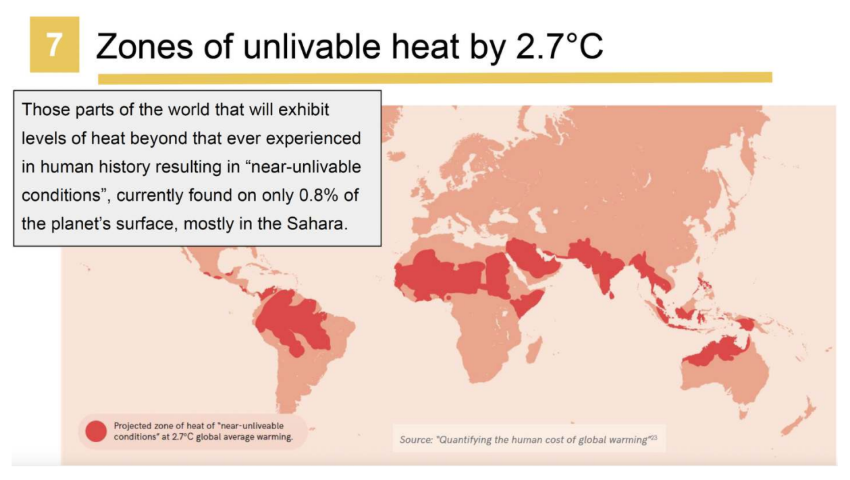
As reported, a significant portion of South America's 438 million people will be forced to relocate, as will many of Africa's 1.5 billion people, and approximately 2 billion people in Southeast Asia.
These regions comprise some of the poorest nations on earth, as well as two nuclear superpowers with a long history of conflict. There are no viable paths for peaceful migration.
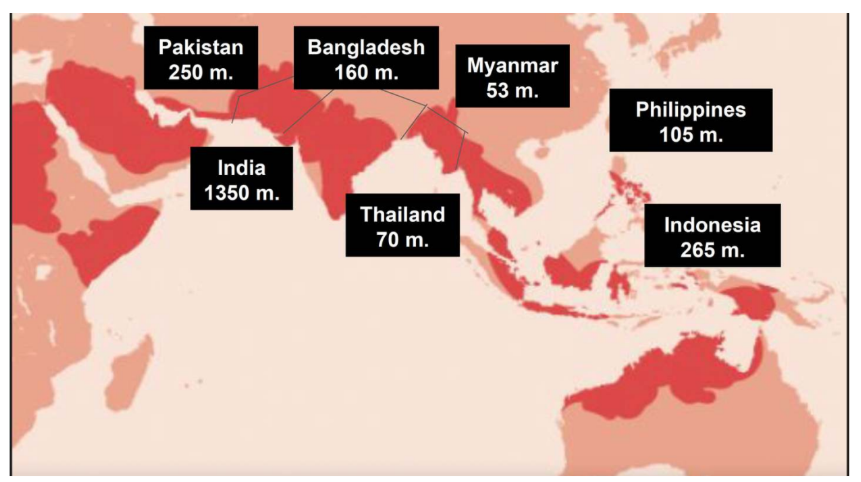
ASIP will provide social science updates on the human and ecological consequences of climate collapse, including a mass-death analysis. Mass death analyses are not new. In other words, the failure to provide this information by the IPCC and other organisations is not because of methodology limitations.
Accelerated heating will also bring serious harm to those portions of the Earth that remain "livable" during the 2030s to the 2060s, although civilisation as we know it will begin to collapse. These consequences include sea-level rise; food crises due to crop failures, drought, and transportation disruptions; water stress; excessive heat; extreme weather; abrupt shifts in ocean circulation that create abrupt shifts in weather; disease; and war. Likewise, ecological collapse will intensify and, in many cases, have an impact on temperature increases. Future ASIP reports will report on these outcomes.
Implementation Process for Analysis 2: Mass Death, Other Human Consequences, and Ecological Collapse
The ASIP mass death analysis will include three elements:
- The creation of a historical library of studies of environmentally related mass death.
- A systematic study of climate mortality by epidemiologists, demographers, and conflict experts will create a rigorous framework for estimating climate-related deaths across scenarios. This team of experts and activists will analyse the human and ecological consequences of extreme planetary overheating.
- The creation of a detailed analysis methodology to predict and measure the mass deaths caused by planetary overheating, including projections of a range of plausible future scenarios.
As with science findings, human and ecological impact findings will be presented in a manner to encourage mass mobilisation and inform citizen assemblies. They will be provided to the public through written and online presentations, presented to be easily understood by non-scientists and emphasise "what this means to you." Emotional engagement is an essential component of ASIP. Decadal projections will be an essential component.
The ASIP human and ecological impact findings project will be organised and managed by 4BD's Science Education and Science Liaison Teams, along with significant participation from the Website/Social Media and Outreach Teams. Given limited staffing, the need for additional funding, and the immediate emphasis on establishing the ASIP science project, the human and ecological impacts project will commence in June 2026.
Conclusion: The Pathway to Human Extinction
At present, there are only two outcomes. First, to maintain a 'highly developed' economy and society capable of rolling out technologies that may lessen the impact of climate collapse. Or the end of humanity's existence. There is no third scenario now, no regression or progression to some premodern society compatible with continued human life. There are only two equilibria. Geoengineering or extinction.
The historical record of the Earth shows that in previous periods of runaway climate change, the result was a hothouse Earth. So, it is effectively certain that after passing five degrees centigrade, human extinction is locked in. The resulting decline in oxygen levels will unfold over centuries, but humanity will not survive in its remaining ecological niches in the long term.
There are other possibilities of human extinction, such as from radiation fallout (nuclear winter) from nuclear war and/or nuclear accidents. But this is not certain. Extinction due to loss of oxygen, however, seems absolute and is locked in once the threshold of 5 degrees centigrade is passed.
We are presently putting carbon into the atmosphere at rates between 8 and 30 times faster than at any time in Earth's history. Recent findings indicate that it is increasingly likely that five degrees centigrade will be exceeded before the end of the century and will continue to rise over the following centuries. The increases, in other words, will not stop.
Escape from Extinction
Humanity has a short window to prevent this runaway climate breakdown, involving temperature increases of half to one degree centigrade per decade. The clear indicator of the coming reduction in fossil fuel use will be the economic and physical effects of the climate crisis itself, as temperatures exceed 2 degrees centigrade in 2035.
This reduction in human emissions, however, has shown it will not stop the exponential increase in natural positive feedback processes, producing ever more greenhouse gases. Given that we now know the starting stats and the ratios for these feedbacks, geoengineering and Earth repair technologies will therefore be essential.
If we are to survive, carbon removal will cost between $20 and $70 trillion per year, according to estimates. The present GNP of the USA, around $30 trillion, is the largest in the world; therefore, an international effort by the USA, European Union, United Kingdom, Russia, Japan, China, as well as smaller economies will be needed to accomplish these objectives. In addition, it will be necessary to significantly reduce temperatures at the poles because their temperatures are increasing by 2 to 4 times the global average to prevent albedo effects. This will require various untested solar management projects.
Lastly, a massive investment of resources will be required to address the direct and indirect consequences of storms, droughts, migration, and economic breakdown, as climate extremes reduce GDP by 10 to 20% over the next two decades. The needed global effort to address these crises will coincide with the need to allocate 10 to 20% of global GDP to carbon removal.
This may be technically possible, but it is far from likely due to the suboptimal political conditions brought on by social collapse, wars, and new nationalist and fascist regimes. The key tipping point in the whole system, i.e., the fusion of Earth and human systems, would seem to be around three degrees centigrade, when objective human, social, and technical capacities will fall below the point needed to remove sufficient amounts of carbon from the air to prevent a runaway temperature increase past five degrees centigrade. The key decade, then, will be 2025 to 2035.
Given the crisis, there is only one climatic analysis that is now useful: an all-system iterative model that uses the conservative frame explained above to provide accurate and understandable data and projections on the ecological and human consequences of runaway planetary overheating. Any part system model will lead to reckless underestimates of temperature increases, because it will not take into account all system interactions, nor the human consequences.
Call to Action
Join the 4BD team. Together, our individual and collective efforts can build a movement with the strength and power to compel the governmental, corporate, and social change needed to ensure our collective survival.
Some argue that individual actions do not matter. The opposite is true. Collective success depends first and foremost on each person's willingness to be a voice for change, to contribute, and to share the truth about this growing threat to all humanity.
This is no time for wavering. Act now for a livable future for our children.
Join Us! We need people, experienced or not, who can give a few hours a week to participate in our 4BD Teams. Please also see here for all future 4BD events. Become part of the solution today!
Consider donating whatever amount you can — to fund the vital work that 4BD is doing.
And please, share this document with all who need to know this truth (clue — that's everyone!)
— Roger Hallam