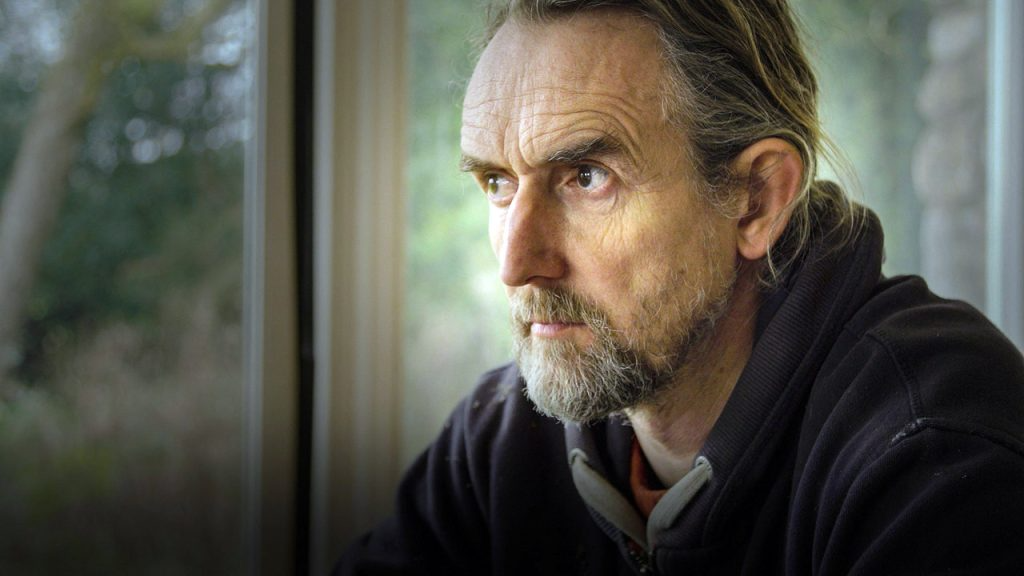
The Insurance Industry Predicts Mass Death
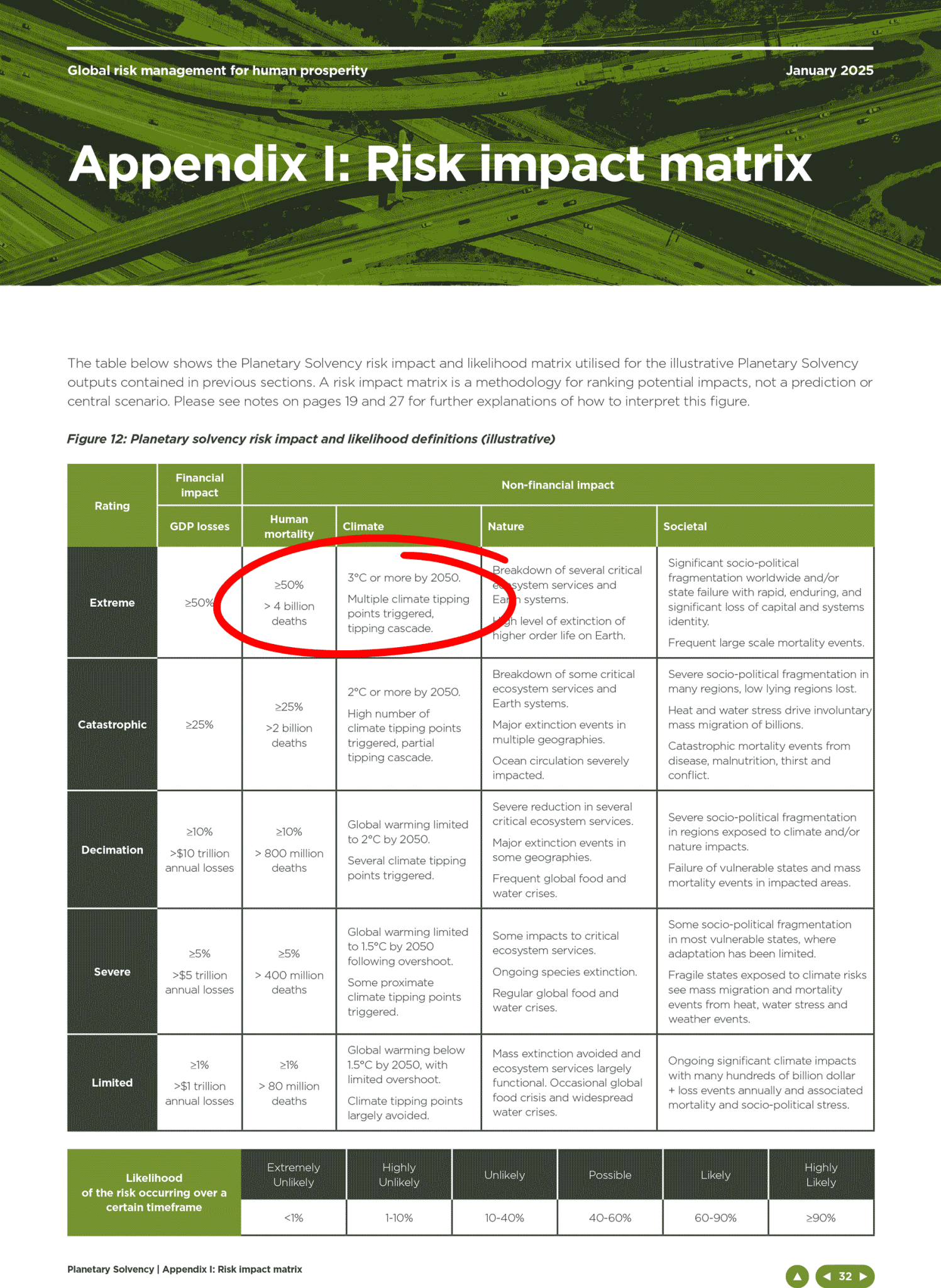
Four billion people dead, buried in an appendix nobody was meant to read.
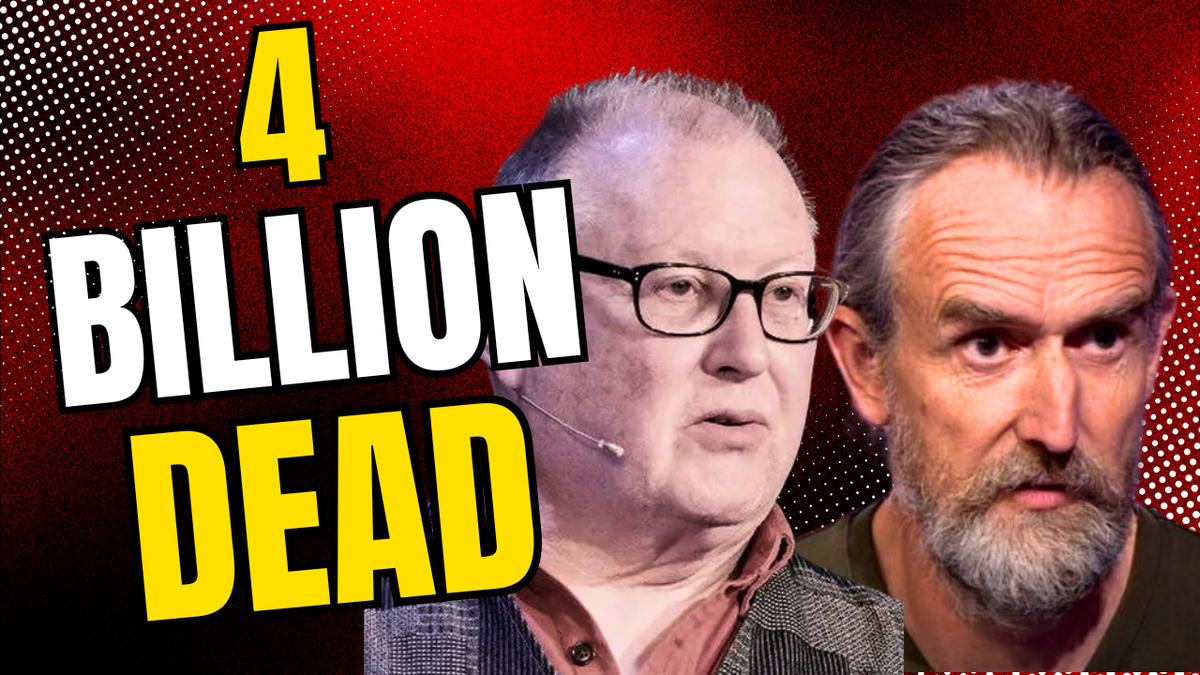
In January 2025, the British insurance industry produced a report estimating that at least four billion people could die this century because of the climate crisis. The finding was buried in an appendix, barely reported, and when it was covered, it took five or six paragraphs before anyone mentioned it.
On this call, climate scientist Bill McGuire and I laid out what that prediction means, and what it demands of us.
Abridged Transcript
Bill McGuire: Where We Are Now
Global heating has averaged more than 1.5°C over the last three years. That figure was never arbitrary. It was the aspirational limit of the Paris Agreement, defined as a guardrail against dangerous climate change. We are now on the cusp of crashing through it permanently, at a threshold that coincides with tipping points including the collapse of the Greenland and West Antarctic ice sheets, which together would bring an unstoppable 12-metre sea level rise.
Because of how these thresholds are measured, we won't officially know we've passed 1.5°C until ten years after the fact. With a hyper El Niño pushing temperatures past 1.6°C, possibly 1.7°C, in the next twelve months, we may only recognise 1.5°C in the rear-view mirror.
The rate of heating has doubled over the last decade to 0.35°C per decade, which would put the 2°C mark around 2040. But satellite data suggests the true rate may be closer to half a degree per decade, meaning a 3°C rise by 2050 is plausible. McGuire calls the idea that current policies point to a 2.6–2.7°C rise by 2100 "complete bollocks." A return to the conditions of the late Pliocene, three million years ago, is already locked in.
To put that in context: our planet has been hotter than it is now for most of its history. What makes this moment dangerous isn't that we've been here before, it's that we haven't. The rate of heating now is ten times faster than during the Paleocene-Eocene Thermal Maximum 56 million years ago, and at least twenty times faster than at the end of the last ice age.
Our climate has already reverted close to that of the last interglacial period, 125,000 years ago, when temperatures were around 2°C above pre-industrial levels and seas were 6 to 9 metres higher. As we continue emitting roughly 41 billion tonnes of CO2 a year, the equivalent of around 800,000 Titanics, we risk rewinding the climate clock further still, potentially back to conditions last seen 15 million years ago, with sea levels up to 50 metres higher than today.
Recent analyses point to societal breakdown beginning as early as 2040, and deaths measured in the billions by mid-century. McGuire's conclusions: every tonne of carbon not emitted is a win. We are no longer fighting to prevent catastrophic breakdown, that's already baked in, we are fighting for survival. And because central control is likely to fragment, we need to start organising now, at the level of town, village, street and block, to secure water, food, energy and safety for the people around us.
James Garfield said, "The truth will set you free, but first it will make you miserable." It is a reminder that hope dies last.
Roger: Four Billion Dead
I take the insurance industry's figure at face value: a prediction, buried in an appendix, describing at least four billion deaths at 3°C of warming. Not people vanishing painlessly, but generations dying through war, social collapse, and starvation, roughly 4 billion deaths between 2050 and 2100, taking global population from 8 billion down to 4 billion.
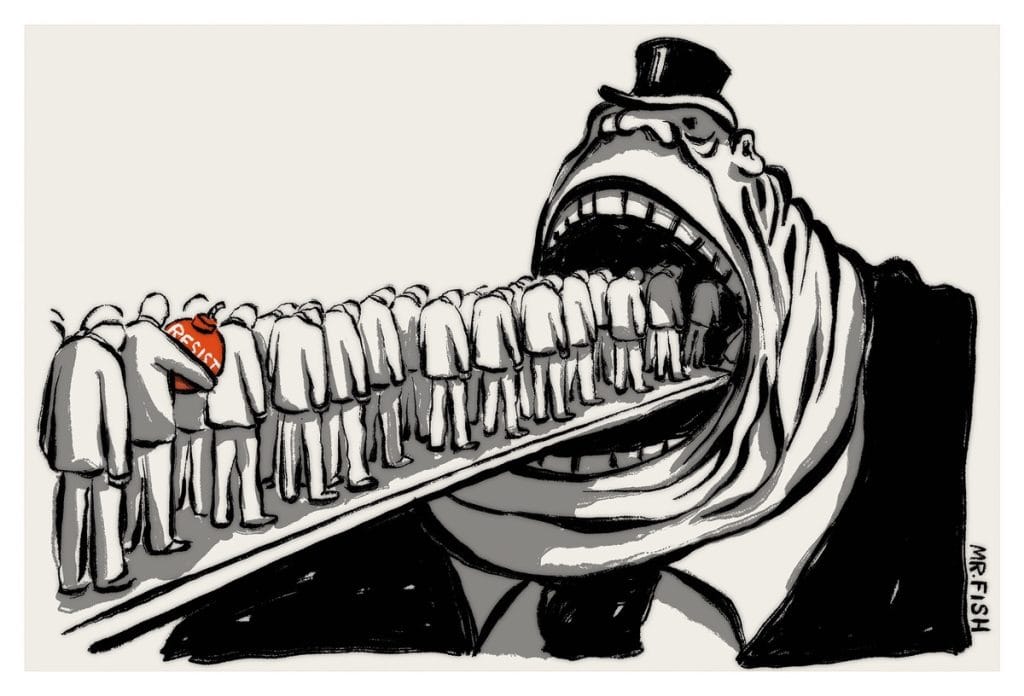
I point to how the report was received. The Guardian's coverage led with the possible loss of 50% of GDP, with the death toll appearing five paragraphs in. My point: a media landscape, even in its liberal wing, that treats rich people's pensions as more newsworthy than the deaths of billions of mostly black and brown people in the global south.
I drew a comparison to scale: if four billion people die, that's the equivalent of roughly 80 Second World Wars over 50 years. At 2°C, the death toll is likely to be lower, but still equivalent to around 40 World War IIs.
I argued this is not a campaign in the usual sense. It's a confrontation with the most extreme possibility in human experience, one that will change how movements operate. The project's response starts small and deliberately unhurried: a photo holding a sign reading "4 Billion Dead," followed by silent processions, bearing witness rather than marching or chanting. I described this as preparation, what Gandhi called self-purification, central to sustaining resistance rather than burning out.
From there, the plan builds outward: larger processions, community-building weekends, and a demand for a legally binding citizens' assembly to address existential risks facing this and future generations. If government won't fund it, the project aims to raise the money and run it independently, with its outcomes becoming the movement's demands.
I was direct about what the project isn't: given the current political climate, it won't organise civil disobedience directly, since doing so risks the arrest of the organisers and the collapse of the organisation itself. Spontaneous resistance will be left to others. Instead, the aim is to build a broad coalition over the next five years, ready for the ruptures ahead, so that when mass death does begin to bite, the response comes from people demanding real change, not from the far right dominating the airwaves.
My closing point: courage doesn't come from sitting alone trying to talk yourself into action. It comes through community, through combining with other people and feeling the strength of doing this together.
How to Get Involved
Maya outlined the first step: take a photo of yourself holding a sign that reads "4 Billion Dead," ideally somewhere with an interesting backdrop, and send it in to be shared on social media. It's a small act, but a refusal to stay quiet about what's coming.
Sean spoke about the next stages: local groups forming around people who've taken the photo, leading into silent processions that bear witness without seeking confrontation, supported by a network offering guidance and materials. From there, local mobilisation, through leafleting, postering and door-knocking, builds toward public meetings, and eventually weekends where people go deeper into organising together.
The ask, in short: take the photo. Help organise or join a procession. Help with a public meeting. Help mobilise your local area.
Two upcoming organisational calls were announced, on 28th an 30th July, for anyone who wants to take the next step.