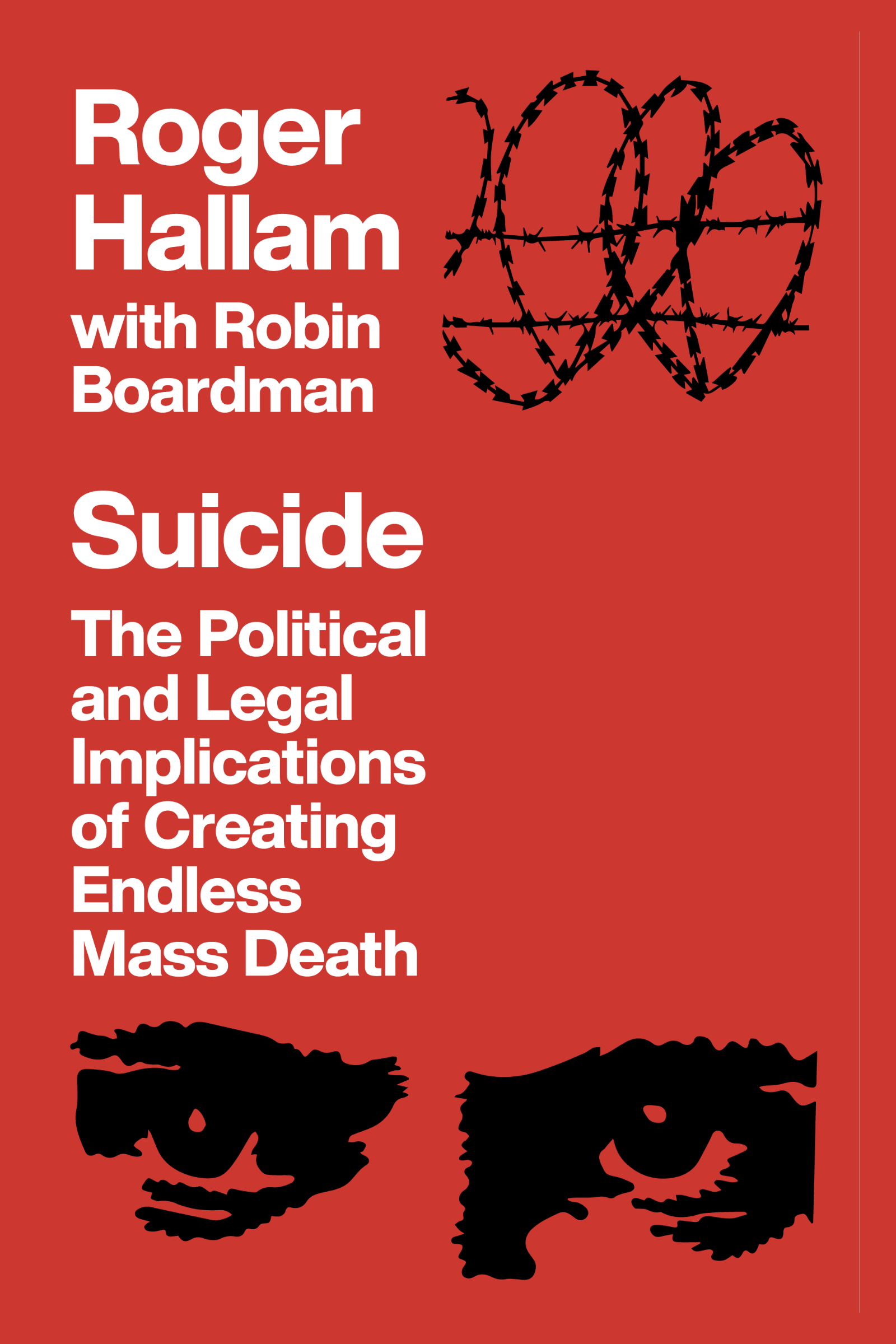
Suicide Is the Only Honest Word for What's Happening
The ruling class isn't trying to enslave us — it's destroying itself, and taking us with it.
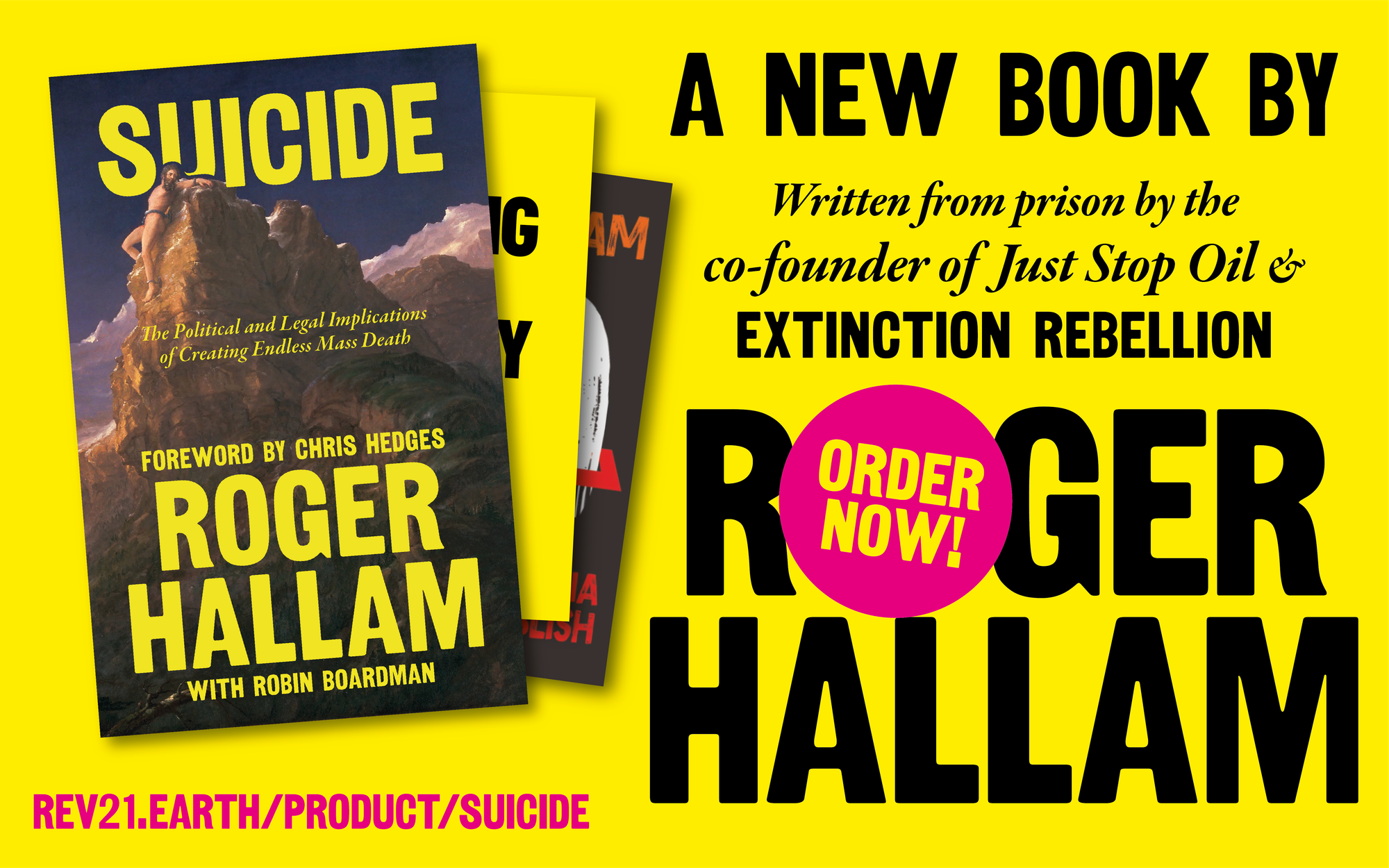
I did this interview with the Climate Agenda podcast last week about my book, Suicide, which I wrote in a month while I was in prison, because the whole thesis from my court trials was already sitting there in my head. The argument is that the rationality project that emerged from the Enlightenment has been betrayed by the liberal class, and that what we're watching now isn't some tragic accident but rather a suicide, in the Freudian sense, not the Marxist one.
In this discussion we go through the judges, the insurance industry's own numbers of 4 Billion Dead, the sociology of revolution from France to Russia, and why sortition and God are the only two doors out of this.
This transcript was tidied up with AI assistance from raw auto-generated captions.
Transcript
Host: In this Climate Agenda episode, I'm speaking with Roger Hallam about his new book, Suicide: The Political & Legal Implications of Endless Mass Death, written while Roger was in prison. The book draws on his own sociological expertise in an effort to shed some light on this strange time in which we are living, where human life, as well as the biodiversity of the planet, are on the brink of passing through the eye of a needle.
Brace yourself for more biblical references and a hard-hitting analysis of what has happened, what is happening, and what dynamics are at play that will lead us into the future. Roger's views are provocative, and I would love to know what people's thoughts are — I do read all the comments and try to reply to as many as I can, so thank you for contributing.
I'm currently recording a new set of episodes, and the next one will be with two authors of a new research report from the Royal Society for the Protection of Birds (RSPB) about their findings on how extreme climate change is threatening vulnerable UK bird species. We need to act now if we're to avoid mass death of British birds in the coming years.
I'm also interviewing the chair of the UK's National Emergency Briefing, Mike Berners-Lee, to discuss why we need a mainstream National Emergency Briefing to help the country prepare itself for an increasingly hotter and riskier world for all of us.
Thanks to everyone who listens, comments, shares, and subscribes. It is greatly appreciated.
Host: Roger, it's great to see you. Thank you very much for taking the time. We want to talk about your new book, Suicide: The Political and Legal Implications of Creating Endless Mass Death. And mass death from climate destruction is very much now on our doorstep, and collectively we are ignoring it, making excuses about why it's not really happening, etc. Just starting from the title of the book — can you describe the relationship between mass death and this so-called machine that makes it inevitable?
Roger Hallam: Yeah, well, thanks very much for having me on, and thanks very much for your audience being courageous enough to listen to me. You can switch this off at any point if reality becomes too straining.
But yes, I mean the main point of the title is basically to put a title down that absolutely no publisher would be able to cope with — a sort of statement in and of itself. You know, Suicide: The Political and Legal Implications of Creating Endless Mass Death. Every one of those words is important.
The most important word, obviously, is suicide — that we're not dealing with a ruling class which is going to do the traditional routine, which is to take the social body and turn it into slavery and mass death to the extent that it creates slaves, which is the historical norm. What, in the end times, the ruling class does is destroy — destroy the population and destroy itself. Destroys means kill. So it's a suicide project. It's not a traditional Marxist-esque "the ruling class is trying to exploit us all." So it's more of a Freudian orientation than the Marxist orientation — the death wish, and such like.
And yeah, I mean the other thing to understand then is that the agency here is a system of being and a system of operating which came in, broadly, with the Enlightenment and the creation of modernity. Most listeners will be aware of the various facets of that — reductive materialism, separation from nature, an imperialistic attitude towards the other, and good old-fashioned ruling-class death wish. Ruling classes regularly destroy their populations through various mechanisms. So there's nothing unusual, except that this time round they are going to destroy the whole system.
Host: Coming back to this idea of suicide, and the fact it's almost like the framing is that it's a choice — I remember Professor Kevin Anderson quite often said "we are choosing to fail." From your own experience, what makes the system, or this idea of this machine, so strong that when individuals or communities or broader organisations, like the UNFCCC for example, try to warn us or steer us in a different direction, they get smacked down? What makes that so strong, that smacking down?
Roger Hallam: Well, the root cause is this paradigm, or ideology, which has got various facets, but I think it actualises itself into two main moves.
The first move is the greed of the ruling class, the elites — which is the traditional explanation, as you might say. They've got the power, they don't want to lose the power, and obviously they will do what is necessary to defend that power. That's the first thing.
The second thing, overlaid on this, is the ideology of instrumentalism. And what, paradoxically, the ideology of instrumentalism does is say you should only act if you're going to succeed — which creates the mother of all collective action problems. So no one thinks it's worth doing anything, because it won't work, because not everyone else is doing it at the same time. But it's important to understand that the collective action problem is the ideology of capitalism.
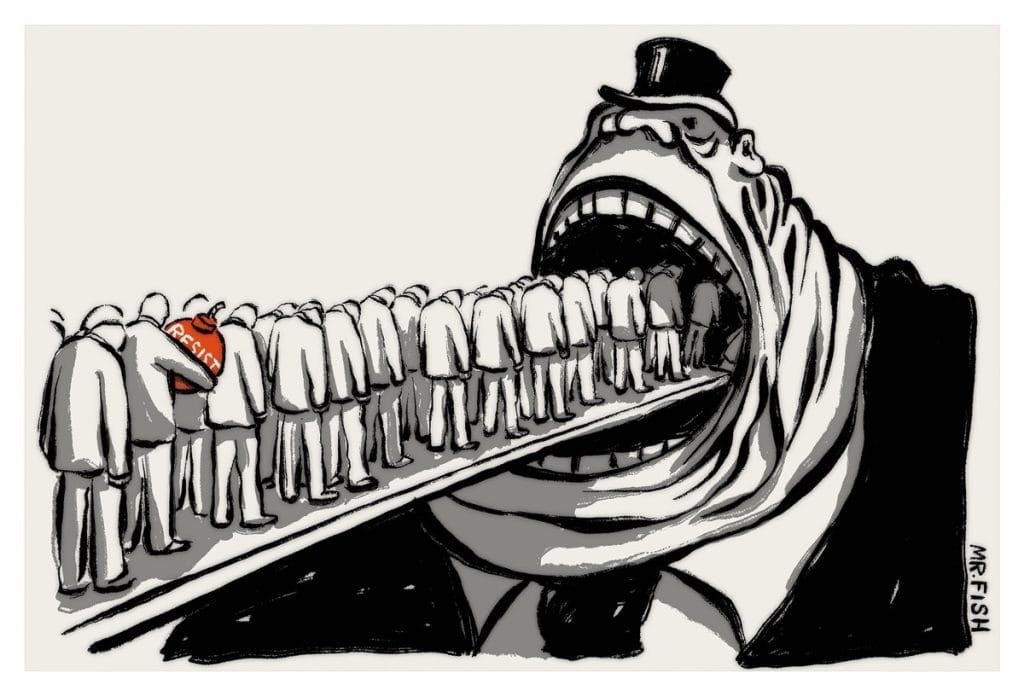
Traditionally, in societies before the tragedy of the commons and such like — there's lots of literature on this, as people probably know — societies were based around virtue ethics, in other words traditional taboos against individualistic free-riding. So the community would come together and prosecute, or persecute, anyone that was free-riding, for the very obvious reason that the community would not survive if people adopted what is now the standard capitalistic orientation towards the world, which is "screw what you can while you can and don't think about the future" — which is obviously materially suicidal, but also heretical in a wider sense to what it is to be part of a human community.
Host: You talked about this collectivism, this "what can I do amongst all of the things" — this idea of agency, I suppose. In your journey so far — with all the exile stuff, all these other things — how successful do you think you've been in breaking through that, and where do you think that brings you now?
Roger Hallam: Well, I think how I see the situation is that the liberal class is basically the centre of the ideology of the collective action problem. I think the folk traditions which are still maintained even in the western working-class or lower-middle-class — i.e. being decent, doing your duty — have been decimated by the liberal class, which has adopted the neoliberal orientation since 1989. And I think it's important — and lots of people who are a lot cleverer and more courageous than me have said this over the last thousand years — that the problem with evil is not the people who are evil. The problem is with the class of people that facilitate that evil in full knowledge of the evil they are doing, because after all these are the educator classes. So the educator classes are really the main agent of the suicide project. The ruling class cannot get its way unless there's lawyers and lecturers and doctors and media people who facilitate the lies and the euphemism and the dampening.
So for me the liberal class has won, and paradoxically has committed suicide as a result, because over the next 10 years the liberal class is going to collapse — the only things that are going to come out of the next 10 years are a revitalised left and a fascistic right. And the liberal class, if you're going to be moralistic about it, have only got themselves to blame.
I can give you one or two obvious examples of this. The liberal class has promoted two fundamentally bogus ideas. The first idea is that when we go over two degrees, that has to be the average of the last 20 years. This makes no statistical sense — it's pure ideology, because as we all know, if a data set is going up continually, then obviously you need to take the average of at best the last three years and the projection for the next two. If you take the average of the last 20 years, you come up with a nonsensical average. This is like putting boiling water into a bath and saying you're not boiling yet because for the last 10 minutes the average temperature was quite low. This is 101 rationality.
So the liberal class has indulged in this nonsense, and this isn't a small matter, because the single biggest stat in the world is: what is the average temperature? We all know the average temperature is now, you know, 1.5 — but you go to anyone in the climate industry and they'll push the idea it's 1.3, or even 1.2. This is criminal stupidity. And the second nonsense is — we've got, what is it, maybe you'll correct me — something like 25 more years of carbon budget before we reach 2°C. This is the most bogus bollocks in the history of humanity. We're at 1.5°. In the last 10 years, we've gone up by 0.4. So we're obviously going to hit 2°C around 2035, 2038. Nothing's going to stop that unless there's a revolution. And obviously liberals don't want a revolution, so they more or less condemn people to 2°C — but no one's telling the British public that we're going to hit 2°C by 2035, 2038. And this assumes, of course, that there isn't a nonlinear takeoff in the Earth's feedback systems, which arguably there's a 50/50 chance is going to happen.
You see what I mean? The whole industry, as you're well aware, Nick, has a level of stupidity that would make any Enlightenment philosopher turn in their grave and want to kill themselves — or they're already dead — because the whole Enlightenment project has created this absurd, beyond-words stupidity that the liberal class promotes.
Host: One aspect of what you said — we are committing suicide — is we have, or we are, whatever, each other and the other. You're saying, unless we change course, unless we change our trajectory —
Roger Hallam: I'm not saying anything, I'm making an analysis. I'm not making a — I'm not suggesting we then proceed to some sort of vague abstraction called "we need to change course." That's the language of the liberal class.
Host: Okay, but the word you would use is revolution?
Roger Hallam: Look, there's going to be revolutions anyway. That's the first point — it's locked in. This is my own specialism — I'm just going off O-level maths to predict that we'll be at 2° by 2035, 2038. Anyone who thinks that's not going to happen is beyond dumb. The slightly more complicated analysis is when revolutions will happen, at least in Western societies. In the majority world, the main scenario is that there'll be dictatorships and levels of chaos, because those nation states are not well established. Within well-established nation states, the default is revolution when the ruling class tries to destroy society — French Revolution, Russian Revolution, American Revolution, in that classical sense. So the first thing for anyone who's vaguely interested in reality is to interrogate what these revolutions could and should look like, in so much as they are now inevitable.
And the broad debate is whether the default will be fascism or whether the default will be a revitalised democracy. But that construction in itself is hopelessly secular — and I can talk about the religious elements in a minute — but this is where anyone who's got any sense needs to situate the debate.
We've just got a new leader of the Labour Party, Burnham, who has zero intention of doing anything other than tinkering around with, you know, converting the electricity supply, which everyone knows is beyond pathetic. It's Marie Antoinette territory — let them eat cake. That's the level of stupidity we're looking at.
Host: You've also quite purposefully, I think, referred to it as the climate industry. There's a Climate Week in London as we speak, mostly being cancelled because of extreme heat, but that's going on at the moment — and many scientists and all the people involved stop short of using language like the title of your book, as you said, no publisher would want to go near it. You've reiterated the need for telling the truth, both just now and constantly throughout all the work you've done. How effective, how do you think it's been so far? Because I remember interviewing Jim Hansen in 2012, and I said, "Can't scientists do more to communicate what's going on?" And his reply was: "Well, if you run around with your hair on fire, after a while everyone just points at you and says, hey, look, there's that guy with his hair on fire again."
Host: And do you think there's some of that in all of this, or does it just not matter? Do we just plough on? Because it's very difficult, if you've been doing this for a long time, to keep doing it when the response is, as you say, that collective shrug and people say, well, this is it, whatever.
Roger Hallam: You have to take a long-term anthropological view of what the human does. There's basically two main traditions. There's a virtue ethics tradition and there's a utilitarian instrumentalist tradition. In human history, the virtue ethics tradition is broadly associated with a religiosity, a religious orientation towards what it is to be alive for 70 years in this particular sliver of reality. And the other orientation is to ignore all that sense of being and to pretend that reality is a machine, and you press button A and you get result B, or whatever. So these are two very different paradigms, and it's not like one is necessarily intrinsically better than the other. Obviously instrumentalism is important — after I've done this interview I'm going to walk to the Tube, I need to know where the Tube is, obviously I want to take the shortest route.
The problem, as Iain McGilchrist and a hundred other observers have written long books about, is that if the instrumentalist side of human culture becomes dominant, then the human becomes stupid, because they don't know why they're doing what they're doing. They've lost their moral compass, and a bunch of other dynamics follow.
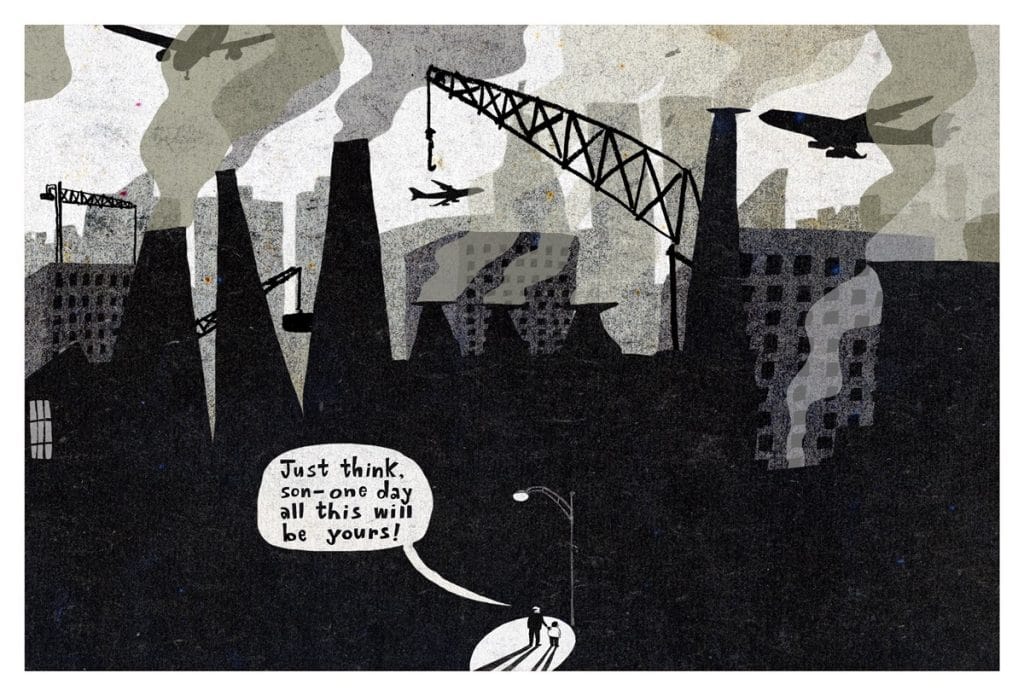
But the fundamental point here is: the very question "what is to be done" is the reason we're going extinct. And the question "what does it mean to live a good life" is the very question that will save humanity, in so much as it will be saved. Because when you ask the question "what is it to live a good life," or variations on the theme such as "what would God have me do" or "what does it mean to be part of the universal consciousness" — you can do the quantum physics routine, you can do the Christian routine, you can do the Stoics' routine — all these are basically variants of the same thing: we are not responsible for the world, we are responsible for our reaction to the world. That's what we're in the world to do. We exist to be good. If we're not good, then we get mentally ill in the secular version, or we go to hell in the religious version.
This is the perennial philosophy that people have been saying for the last 5,000 years. For the last 30 years, in the neoliberal period, we've just forgotten all these traditions, because they've been systematically patronised and removed from the public sphere.
So whenever I go on an interview — you do what you've just done — people say, "Well, Roger, what do we need to do?" And then I have to explain that's not the main question. The main question is: are you going to be an arsehole, or are you going to be a good person? If you're not going to be an arsehol, then you have to be in resistance. In the same way as in Nazi Germany — you can just go along with the situation, and for the next 10,000 years people think you were an arsehole, or you can actually do the business and go into resistance. You might die. You know, that standard orientation towards the Nazi period.
The period we're in now is not going to kill, you know, 50 million people. It's going to kill 4 billion people, according to the British insurance industry, who presumably know what they're talking about — you go and look at it in their appendix. The proposition that we are going to sort this problem out is for the birds. It's irrelevant. The key issue is: are you going to actually be what it is to be human? And if you don't know what it is to be human, then read some mysticism.
You are going to die at some point. Nick, how old are you — 50, 60, I don't know how old you are — you're going to be dead in 20 years. At a certain point you're going to be slobbering around on a hospital bed thinking about what you did in your life, and you're going to be thinking, "Well, at least I interviewed Roger Hallam, and no one else interviews him because he's too scary." And then you're going to have a sense of peace. You see what I'm trying to say?
I've been saying this for ages, and obviously, until — as Steve Keen has said — until white people are dying, there won't be the spiritual crisis which will enable white people to transcend to a virtue ethics orientation. And this, at the moment, is the whole situation — it's the extreme denial before the explosion of reality, if you see what I mean. This is another phenomenon that's well researched in the literature: before the crisis, people don't go into less denial, they go into more denial. Look at the 2001 internet bubble — they all knew it was going to happen, but that made them even more sure they weren't going to resign their jobs. This is called predictable irrationality.
Host: You asked a very direct question — not just to me — you said, are you going to be an arsehole, are you going to, what are you going to do faced with this huge thing? I'm not so much asking you what the future plan is to change trajectory. I suppose it's — when so much of us are captured by legal frameworks, political ideologies, media, social, judicial, commercial, all this stuff that makes up our construct of the world we live in — and you start picking it apart, and then you say to that person, well, look, the climate's breaking down, virtually all the nature around you is dying, and you're importing everything from so far away you'd have never even heard of the place — and they say, "Yeah, I know, but I just want to get the upgrade on my new phone, and a new car, or whatever." Isn't that the gap where it's very difficult to break through? I have this with my own old friends — they're just not interested, and I'm amazed. But it's —
Roger Hallam: You were amazed because you're, you know, an Enlightenment idol — no disrespect. Most people, historically, aren't Enlightenment ideologues. Basically, they're children of God. That's how they see themselves. For 99% of human history, religion was the main thing in people's lives. In the world at the moment, something like 80% of people are religious, depending on your definition. The class that you belong to — and I belong to too, to a certain extent — is the 1% of humanity, and 1% of the history of humanity, that thinks there's nothing other than calculation. And this is a form of madness.
The reality is this: we are absolutely free, in any moment, to do whatever we want to do within the physical limits of time and space. You can decide tomorrow to go down the street and take all your clothes off and cover yourself in blood. There is nothing physically stopping you from doing that, Nick. This is what Sartre was saying — he was saying it's bad faith not to accept the absolute freedom of being human. People have been saying this for 5,000 years. The notion that you cannot change is pure ideology.
You can do whatever you like. And the reason why people don't do this is the paradox — the reason people don't do whatever they like is because they tell themselves, and other people tell them, and there's a herding mechanism, that you can't do whatever you like. And this is the function of prophetic witness in the historical record. In the neoliberal period, the notion of the prophet is at best patronised and at worst looked upon as some sort of cult routine. But the prophetic witness function in human society is absolutely vital, because someone gets up and actually says: we're free, and you have to do the right thing, otherwise you're going to go to hell — and that can mean material hell, or various definitions of hell. It can be a spiritual thing, it can be a material thing, it can be a post-death thing, or all three in different variations. And that's what's missing.
There's about three prophets in the world — there's me, there's Greta, there's two or three other people. And at a certain point there'll be a critical mass of these prophets, and we'll probably all get shot or something, because that's what happens. But the upshot of it, sociologically, is that those prophets get shot, and then they have like twelve followers, like Jesus, and then thirty, seventy, three hundred years later — depending on the density of the network connections — they basically become the new hegemonic ideology, because if they don't, the society will die.
That's how it works. The whole liberal class talking to itself in what I call left defeatism — "oh, we can't do anything because it's so difficult, and the oppressed are so oppressed, and we're so oppressed, and we can't do it because of the collective action problem." These are the machinations of collective madness, of spiritual poverty. Just read some of the Old Testament, for God's sake — you're a total outlier in terms of the human experience.
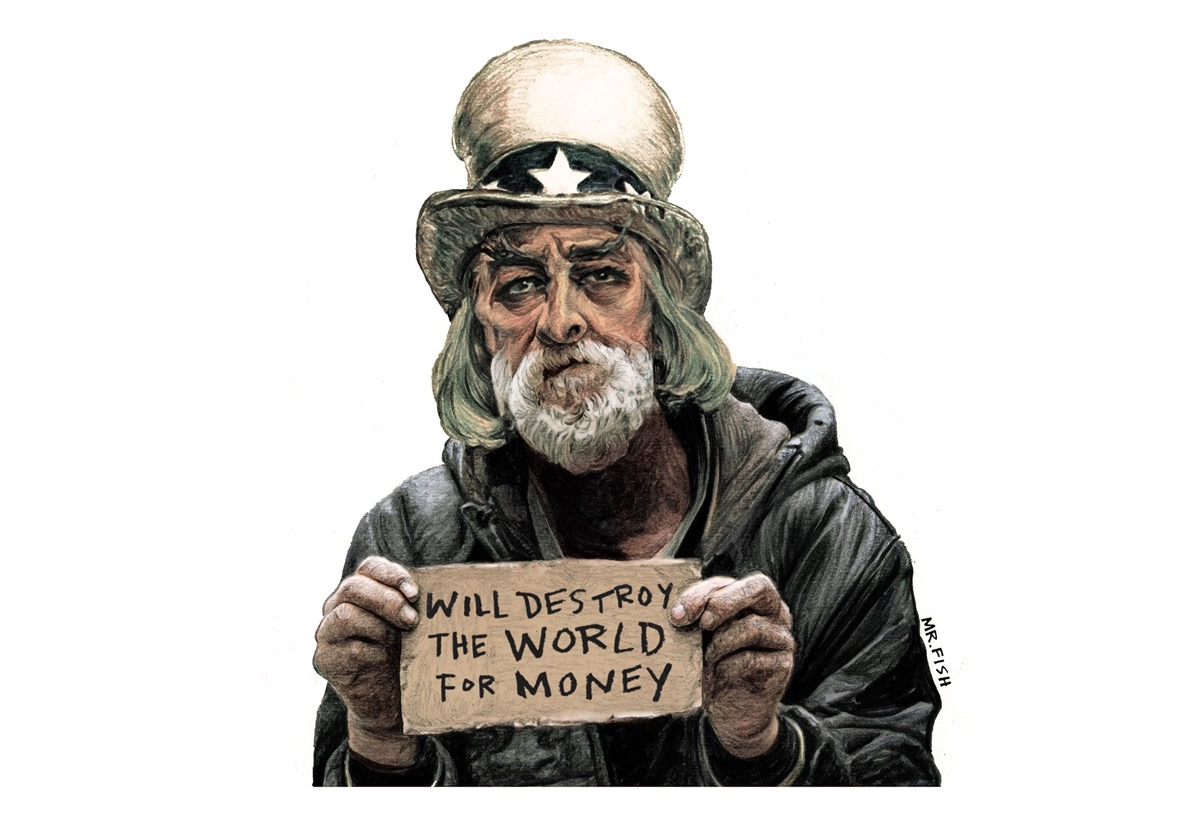
For me, the best analogy is Marie Antoinette — the main historical meme of the arrogance of privilege leading to the most chronic level of stupidity. There she is on her farm, pretending she's growing veg, and all around France the peasants are literally starving, and then she says, "Well, let them eat cake" — and everyone laughs about it, because we all think we're nice liberal rationalists. But that's what we're doing when we're saying, "Oh, it won't be 2° until 2050, so I'll still get on a plane to go to a conference in Berlin, because I'll work there." And the fact is that everything we're talking about is happening right now. And to be honest, it's no surprise it's happening right now, because 10 years ago — in that Hansen interview, 2012 — he said if we wait 10 years before we start bringing down emissions, it won't be possible to do it within the society we have, because of the ramifications of those changes. And we've gone way past 10 years, and emissions are still going up. And that comes back to this idea that this was the choice society has made, and we're following it through.
Host: I just want to come back quickly to something you said about going to hell. The last time I interviewed you, you were awaiting sentencing, and you went to what I think many people would regard as hell, which is prison — and the book was written in prison, I believe. In everything we've just been discussing, that's a very relevant threshold to cross, a Rubicon, if you like. Can you talk a little about how the book came out of that, and how that's impacted your activism? How do you feel about everything you're talking about and saying?
Roger Hallam: Well, just as a little aside — I've never described myself as an activist, and I've never been an activist as far as I'm concerned. I'm a revolutionary. I want a fundamental change in the government structures of Western societies. So we need to call a spade a spade.
That's one thing — I just wish people would stop calling themselves activists, on the assumption that they want to be historically accurate about the attitudes they have towards the political class.
The second thing is: going to prison has the potential to be an ecstatic experience as much as a hellish experience, because basic psychology shows us that, whatever's happening in reality, you choose how to react to it — and the extent to which you choose is a function of training, whether you call it spiritual training or psychological training. I've been training in various ways since I was in my early twenties to look upon whatever's happening to me as something I have the freedom to interpret. So my own interpretation of being in prison for a year and a half was: it's fucking great. I get up in the morning, I get my food, the sun's shining, I read my books, I do my writing. It's fine. It's fine.
Which isn't to say really bad things couldn't happen on a material level, and other people, obviously, as a matter of observation, interpret their experience in other ways. So, again, I'm trying to continually break out of the assumptions of your questions, Nick. I think the reason I wrote the Suicide book — and I wrote it in about four weeks, because it was just in my head — is basically the thesis that the rationality project since the Enlightenment has been betrayed by the liberal class's thinking in the neoliberal period. And arguably rationality, in and of itself, leads to irrationality, for lots of reasons I haven't got time to go into.
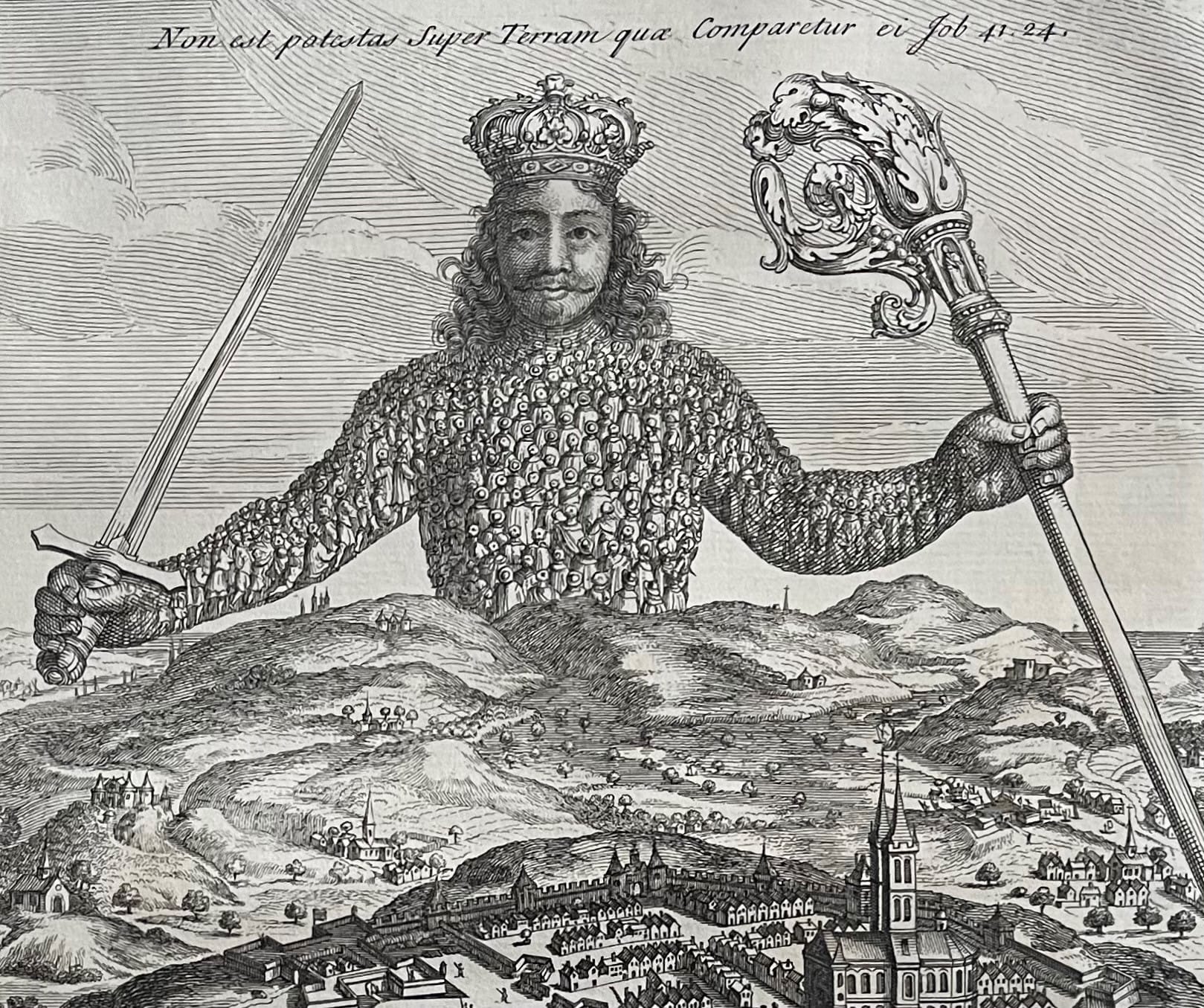
But the specific instance I talk about is the judges. The big problem with the climate movement is it approaches the judiciary from a human rights point of view. It needs to approach the judiciary from the ideology of the judiciary, which is Hobbes. Hobbes says, as we all know, that unless you impose order on society you have brutish, short, nasty lives, or whatever it is. Okay, let's assume that's correct within the ideology. As everyone knows, there's an exception — which is when the agents of the state are destroying the state through their own actions. Then the Hobbesian logic reverses: it's absolutely necessary to rebel against the state in order to save the state. You see what I mean?
So all the judges should be in prison by now, if they were rational and looked at the stats. The British ruling class is destroying the British state. Within half a century, British society will be destroyed. Well, that's what's commonly called treason — you knowingly engage in actions which destroy your state and society. All the stats are out there, as you well know, and people like you spend every week trying to tell the world what the stats are. British society is now going to get destroyed, with something like 90% probability, unless there's a massive revolution in the next three years, let's say, give or take.
So what I'm saying here — I'm using that as an example of the absolute irrationality of the rational judicial class. They're so fucking stupid, they can't actually work out what their own ideology means. There's no Cromwells in there who work out that the king is basically betraying the British state and you need to have a civil war and overcome the king.
You see what I'm saying? That's a personal thing too, because I stood up in court and said I need four hours to explain why the Hobbesian analysis requires absolute revolt, and obviously the judge said no, you're not doing that — and I said I was going to talk anyway, and he got very upset and left the room as if he was a five-year-old who couldn't cope with a bit of debate. Then the police came in and dragged me out of the dock, because of course I'm pursuing a British civil war orientation. In the English Civil War, the courts were a centre of political struggle — people were always throwing each other into the Tower of London and all the rest of it — because the law had been politicised by the king in order to maintain his illegitimate power. And the ruling class has politicised the courts in order to make sure juries don't hear that, basically, you're all going to die.
And when, every now and again, there's a glitch in the system — a friend of mine was in court a little while ago, and maybe the judge was having an off day or something, but he allowed an agreed fact to be entered that at 3°C, 4 billion people will die, because that's what it says in the British insurance report. Do you know how long the jury went out for? Fifty minutes. Came back unanimously not guilty. Well, obviously, if you're Mrs Jones and you're told 4 billion people are going to die, what are you going to do? You're obviously going to come back into the courtroom and say, "What the fuck." Statues should be made of these people, for God's sake.
In my own court case, we were allowed to speak for twenty minutes, and then we were all dragged out of court because we refused to leave the witness box. It was great stuff. The Guardian was there, and they did their usual liberal shitty response, which was, "Oh, isn't this interesting, the hobbits are getting dragged out of court." They should have made a statement saying they believe there should be rebellion against the British state, because apparently they believe in human rights and the British state is facilitating the destruction of the British nation. But obviously they're not going to do that, because they're total cowards.
Host: As you've spoken about this liberal mass of the UK, what we've seen recently is a splitting in politics, or fragmentation, maybe. The Greens have developed a voice and a position. The far right have got their position. Labour is now finding its voice, in Burnham again, which is more of a left-wing voice. The Conservatives have virtually vanished, from what you've been saying. It feels like the liberal order is fragmenting, and people are trying to figure out — well, none of this is working, so where do we go? Do you think we're at that vital signpost moment where, hopefully, people do think this is untenable — we have to stand up, our food systems are going to collapse, nature's collapsing, and policies don't make sense?
Roger Hallam: Well, I did a video people might want to watch, because I'm going to make some slightly outrageous claims over the next five minutes, or even more outrageous claims, from a liberal ideology point of view. So I'll preface what I'm going to say — there's a video called — Pivoting to the Endgame, where I go through this in about an hour and a half. But basically there's something called the sociology of revolution, and it goes something like this: the ruling class starves the state, which is what the ruling class does, and this is why revolutions happen. In the French Revolution, the French ruling class wouldn't support the king, even though he was having wars and needed the money, so the state ran out of money, and then they had an assembly, and it all slid into a revolutionary episode.
The other classical example is the Russian Revolution. The Tsar and his regime refused to make peace with Germany. And objectively, in the same way climate science is objective, military dynamics are sometimes effectively objective — the Germans had far more materials, discipline, and organisation. So there was a revolution, because the Tsar refused to do the objective thing, which was to make peace with Germany. Then what happens is the liberals take charge. What the liberals do is talk revolution but not enact it — they'll say, "Oh yeah, we need to revitalise Russia," but they won't do the key thing the Russian state needs to do, which is make peace with Germany.
Instead, in July 1917, they launch an offensive against the Germans, totally driven by a sort of "motherland" liberal nationalism — the Russians will overcome the Germans. It's totally bollocks: the Russians advance for about two hours, and then the Germans advance 400 miles in a fortnight, or something along those lines. So the liberals are discredited, which makes way for the Bolsheviks. The Bolsheviks were sensible enough — because they had a rational strategist called Lenin — to work out that you need to make peace with Germany, as a material analysis. Everyone hates the Bolsheviks at first, because they think they're betraying Mother Russia, so they get nowhere. But after July 1917, they become the main show.
So it's what you might call a cascading across the political space that happens as the ideology of the liberal class, or the ideology of society, hits physical reality. That's basically the thesis, and it's totally sociological — I'm not saying the Bolsheviks were good or bad, it's just social dynamics in terms of the relationship between physical reality and ideology.
Basically, in the present moment, the function of the climate is the same as the function of the Germans on the Eastern Front in 1917 — a physical reality which is coming. And what Burnham represents is like the Kadets — the Russian liberal party. They go, "Oh, we don't want full-on aristocracy, we don't want the Tsar, we want" — Burnham-esque liberalism, basically — which means they talk the talk but facilitate the destruction of the British state, because they won't slash carbon emissions. I mean, obviously it's complicated because you need everyone else to do it too, but the fundamental point is these are transitory noise in the run of history. Who remembers the Kadets? You've got to be a total nerd to remember the Kadets — they thought they were going to be the new ruling class of Russia, but they clearly hadn't read any history.
So the people who are going to rule the UK are either going to be the fascist right, or something to the left, in inverted commas, of the Green Party — and the Green Party are like the Mensheviks, if you want to put it that way. They'll do some of the business, but they're still nice liberals at the end of the day — they're not going to tell the British population that, within 5 years, you're going to have food rationing, you're not going to be able to fly any more, and all this standard state-socialism stuff. That will be standard, obvious stuff by about 2035. If you don't believe me, just think about the temporary state socialism in the middle of COVID — there was a threat to the continuation of British society, so they brought in an authoritarian regime: you're not allowed to go out, you can't do this, you can't do that. The climate is basically an ongoing, long-COVID-style regime — that's what we're looking at. I don't know what you think, Nick, but I'm putting my bets on somewhere around 2035, with a strong outlier that the insurance industry will collapse by 2030, in which case it'll be brought forward.
The infrastructure of Western societies, particularly in the warm-temperate and cool-temperate zones, where all the infrastructure is dependent on temperatures staying under 40°C, is going to become bankrupt in the next 10 to 15 years. You're just not going to have the money and the labour to pay for the five or six mass infrastructure things that need doing.
When I did Insulate Britain, I talked to this reform-esque, bald, beer-bellied, 55-year-old builder from Leeds. He was great — he couldn't be lying, so he just said to me, "Look, Roger, basically, yeah, we need to insulate all the houses in Britain." I was going, "Cool, cool, cool, that's what we want" — and he said, "There's no fucking way this is going to happen." Number one, there's not enough people to do it, it's a skilled job. Number two, there's not enough materials. Number three, if everyone else is doing it at the same time, there aren't going to be any materials anyway — they're going to have to do it in Scandinavia, Germany, France, everywhere in the temperate regions where the houses aren't already built.
So, in other words, it's not going to happen. The analysis is: the British state is going to go bankrupt in the next 10 to 15 years. The main scenario is we're going to go into a Downfall-esque downward spiral — everyone drinking themselves to death in the bunker in 1945, dance now and get shot next week, that sort of dynamic, which is well documented in the human experience.
So that's what fascism offers — an escape from reality. What the left, or whatever comes after the left, has to do is create an escape from reality that re-engages with reality on the basis of love, which is basically what Christianity is — the opposite of fascism. The fundamental point here is transcendence is coming one way or another. It's either a fascist transcendence, which is "we're just going to live for death," or a form of transcendence that says, "I don't exist in this world, I exist in another world, the world of God, and I will enact love in this world." And, obviously, all your liberal cynics will say that's a load of nonsense — but I don't know what they're talking about, because this is the fundamental ideology of the pro-social West over the last one or two thousand years.
So what that looks like is: those who are going to engage in prophetic witness need to reintroduce religiosity into the left, because otherwise everyone will just burn out, or commit suicide, or have nervous breakdowns — material reality will become unsustainable for the human psyche. And the good news is that once people have made that transcendence, people are perfectly capable of being calm and pro-social in situations of mass death. There's loads of evidence for that.
Then, for all you liberal rationalists out there, the other thing that's required is sortition-based decision-making, because from a social-scientific point of view, the only way you get maximum rationality is by getting ordinary people in the room with the legal power to set policy on the basis of free and extensive deliberation on what the facts are. And this is the problem with representational democracy, as we all know — it's a herd. It's not just dominated by the ruling class, because the ruling class determines who can stand and what they say, and capital flight if they try to do something rational — it's deeper than that, it's about herding. If you believe X, I believe X, the audience believes X, so you believe X, so I believe X. And the two ways to break that are sortition and God. Sortition is a secular sense of God, because the concept of chance is similar to the concept of God — it's outside human agency, and if there's human agency, then you get herding.
This is quite a complicated point, but what I'm trying to say is what Christians have been saying about nature for the last 150 years, which is: without God, the human destroys himself. It's got nothing to do with whether God exists — that's just the old 19th-century materialism debate, that's not what we're talking about. What we're talking about is that the human has to be subject to something outside the human, and that's what sortition does. This is a complicated point — if you don't quite know what I'm going on about, you can ask me. But in the book, that's what the last chapter says. These are the two doors into some form of survival, or transcendence: one, sortition-based, assembly-based government, which I think is inevitably going to come along — it's waiting in the wings like socialism was in the 1880s. And the other is a return to what you might call normal, where most people don't live their lives in order to make the world better, they live their lives in order to follow some transcendent virtue. That, paradoxically, is how you create collective action.
Host: No, I did follow you, and it's kind of this timeline that we have to process, to go through — because there's going to be a lot of suffering, but there's no end point where we just switch it off in the next 5 or 10 years. It's just that there's going to be a lot of suffering. All of that is a given.
Roger Hallam: Yeah, I know.
Host: But out of that, we've somehow got to get to what you're talking about —
Roger Hallam: The word "somehow" is liberal ideology. What liberal ideology does is say, "It's really difficult to do good things when there's bad things happening." That's empirically illiterate. The historical and sociological record shows the opposite — that when bad things happen, people become good. The most famous spiritual text in Western society is The Imitation of Christ. You can turn to chapter seven and it'll tell you: hardship is good because it brings you closer to God. Basically, that's what it says on every page, 250 pages of it. That's medieval Christianity. Now, we all know, as secular liberals, that's a little bit tricky, because there are various dysfunctionalities of fetishising suffering. But the point is still fundamentally correct — because we all know, from our personal lives, when we're shitty to people and we realise it, or when people are shitty to us, it enables us to grow, and accept death, and become a more mature, sensible sort of person. And this is what will happen on a social level, as everyone who's read the literature is saying — well, unfortunately, only about six people have read the literature, because people don't read The Imitation of Christ any more. But you should go and read it. It was the best book I read — I read 95 books when I was in prison, and the best one was The Imitation of Christ. Not because — just for the record — I'm going to become some fundamentalist, suffering-fetishising Christian. The point is, I'm instinctively a liberal in the deepest sense, in that I believe in a plurality of different ways of being. And what we have now is a metaphysical totalitarianism, where certain ways of being are completely removed from the public sphere. No one's going to let me on TV to talk about The Imitation of Christ, are they? Not until 2030, when everyone's having nervous breakdowns — and then, obviously, it'll all come back with a vengeance.
Host: On that note — transcendental Roger TV in 2030. Thanks very much for going through it. It's totally fascinating, because, as I said, it's now on our doorstep, it's all around us, and how we navigate it in our own worlds is what everyone who's paying attention is trying to get some strength from, I suppose.
Roger Hallam: Just before we finish, can I do a plug — for the 1% of your audience who's going to have a sleepless night tonight because of what I've said. That 1% is very warmly invited to join 4 Billion Dead. I'll put a link to it — it's a new thing, I'm not going to call it a campaign, which involves silent processions with people holding signs saying "4 Billion Dead." And, for reasons I haven't got time to explain — you know, in my book — this will become the next XR. So I'm making a prediction. It's something you can do in five minutes or two hours. It's always good to do something, as we know, Nick.