🏚️ The End of the Nice Life
Britain's energy crisis, its burning cities, its sinking coastlines — and the lie that holds it all together.
Every week now the media delivers the same message in different packaging. A city sinking, a political class flailing, an empire selling death. Scientists are even finally saying the word everyone has been avoiding. Billions. The pattern is consistent and damning, yet we are choosing - structurally, politically, culturally - not to act.
These are the telltale signs of a civilisation in the process of collapse. And the only honest thing left to do is say so plainly. Whatever the consequences.
A City That Is Already Gone
Start with New Orleans. A new study published in Nature Sustainability has concluded what many scientists have known for years: the city has passed its point of no return. Southern Louisiana faces three to seven metres of sea-level rise. Three-quarters of its remaining coastal wetlands will disappear. The shoreline will migrate a hundred kilometres inland. New Orleans — a city of 360,000 people — will be surrounded by the Gulf of Mexico before the end of this century.
The researcher Jesse Keenan, a climate adaptation expert at Tulane University, put it without euphemism: "New Orleans is in a terminal condition, and we need to be clear with the patient that it is terminal."
And yet no politician will say this in public. They say it behind closed doors. They commission the studies, read the findings, and then walk back out into the light and say nothing of consequence. Louisiana's Republican governor Jeff Landry scrapped the $3 billion Mid-Barataria Sediment Diversion project — the one serious attempt to buy the city some time — calling the cost "unsustainable." Meanwhile the US Supreme Court has allowed fossil fuel companies to contest a $740 million ruling for damage done to Louisiana's coastline.
Every decision accelerates the timeline. Every silence costs lives.
All civilisations collapse for basically the same reason: they could have responded to reality but they didn't. Our civilisation is no different.
 Oliver Milman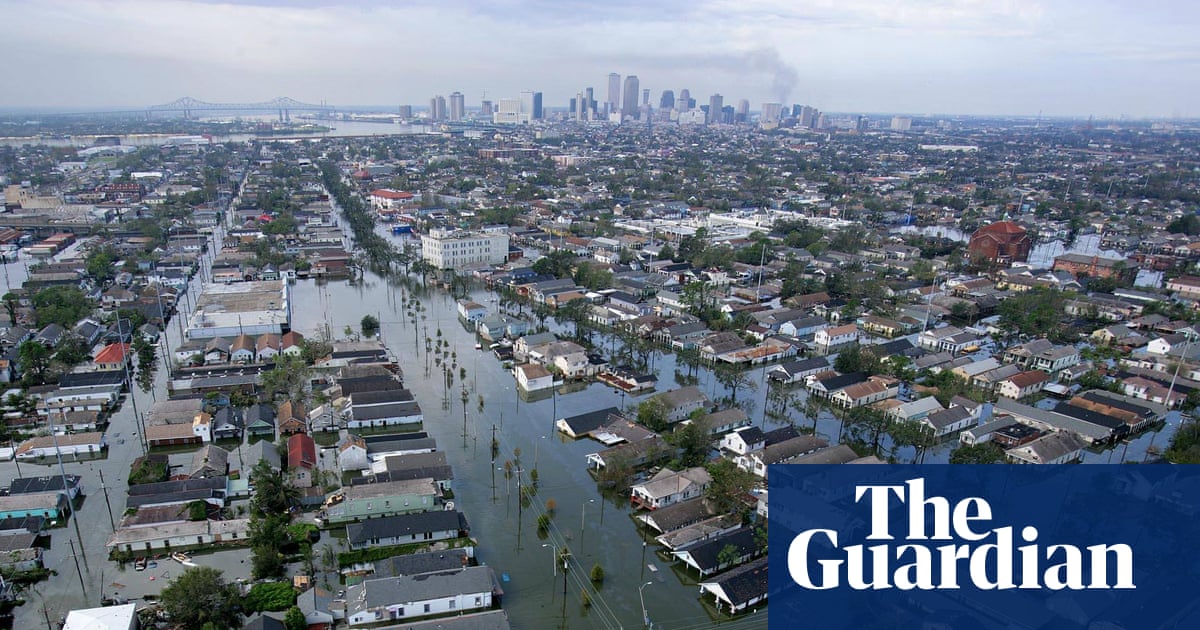
The Language of Billions
There is a word that is beginning to appear — quietly, in appendices, in the careful language of actuaries and outlier academics — that the political mainstream has not yet allowed itself to say aloud.
Billion.
As in: the number of people who are going to die.
When I said that on the BBC's HARDtalk programme, the response was instant dismissal — "you're making it up." But it was never invented. It was drawn directly from a decade of scientific literature, from experts who used more polished phrases like "the end of organised life" — phrases designed to communicate catastrophe while avoiding the social cost of saying it clearly.
Now the word is appearing in unlikely places. Economist Steve Keen has pointed out that 30% of global fertiliser supply has been disrupted through the Strait of Hormuz — and that while the world frames this as an oil story, it is in fact a food story. Without synthetic fertiliser, this planet cannot feed more than two billion of its eight and a half billion people. The numbers do not care about politics.
And the UK insurance industry, in the appendix of a major recent report, has now put a figure on what three degrees of warming means: more than four billion deaths. Eighty World War Twos. That is what "realistic" now means, if you are willing to use the word honestly.
At some point in the next five to ten years, "billion" will enter mainstream conversation. And shortly after that, the dying will begin in earnest. Everything else — every election, every policy debate, every newspaper column — has to be understood in that context.
The Energy Lie
Britain tells itself a story about decarbonisation. It is a comfortable story, and it is false.
Electricity accounted for less than a quarter of final British energy consumption in 2024. Annual electricity production is actually lower than it was at the turn of the century. The growth of wind and solar is only partially replacing the lost capacity from coal and nuclear. Oil and gas still account for 70% of energy consumption — aviation, shipping, heating, industry — none of which electricity can yet replace at anything like the pace required.
The notion that Britain is presently decarbonising with the speed needed to stop runaway climate collapse is the sickest joke in our national politics.
Both left and right are deluding themselves: the right demanding North Sea drilling that would largely be refined abroad and exported anyway; the left championing electrification as if the market mechanisms being relied upon to deliver it could possibly move fast enough. Historian Ewan Gibbs, writing in the Guardian, calls this a "phoney war" — the appearance of energy politics without any confrontation of the actual scale of state action required.
There are only two outcomes from here: socialism or barbarism. Neither will deliver the Green Party's vision of the "nice life" — the quietly aspirational Thatcherism of hard work rewarded with a house and a holiday. Physical reality has closed that door. The future will be hard. It will be blood, sweat, and tears. And it will be "nice" only to the extent that we stop pretending it can be nice, face what is actually happening, stop lying to the public, and get on with saving what is left to save.
That will happen in the context of revolutionary upheaval. Not because anyone wants it to. Because two plus two equals four.
 Ewan Gibbs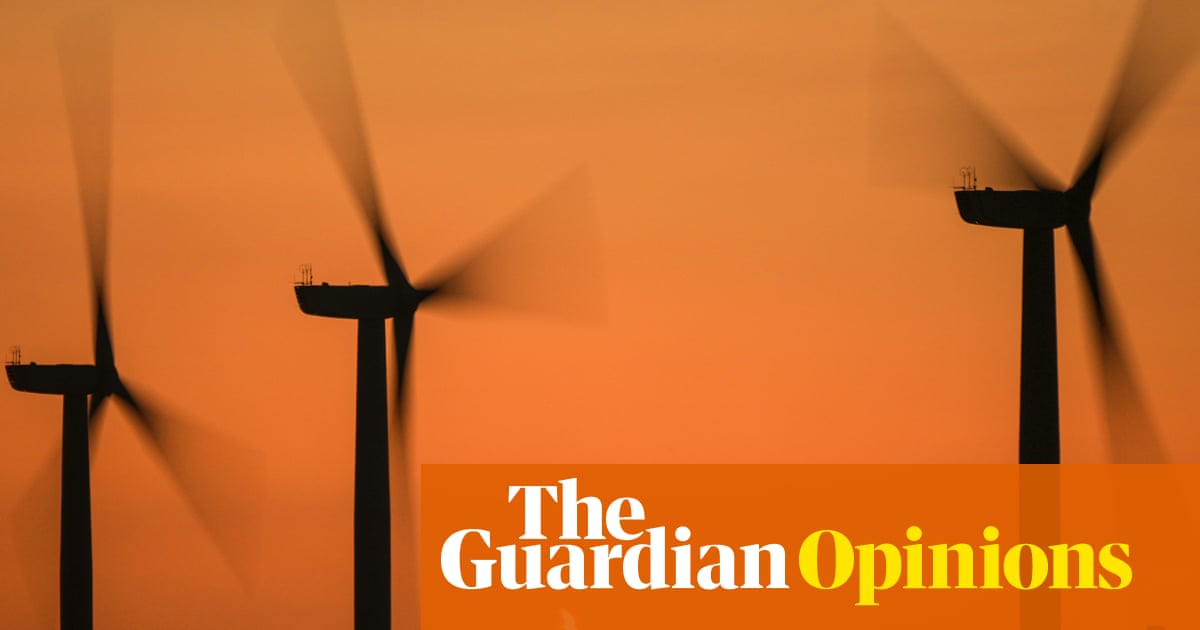
Reform and the Failure of Analysis
As the climate system fractures, the political system does too — and the response from liberal commentators remains hopelessly inadequate.
Reform UK is now the largest party in Britain by vote share. The analysis offered in response by author Daniel Trilling — build a "stop Reform" coalition, hold local councils accountable, challenge their rhetoric — mistakes the present moment for one that calls for radical reform, when it actually calls for something else entirely: a change not within the existing regime but of the regime itself.
The fascists are comfortable with chaos. That is their operating environment. As the pressure mounts — 1.7 degrees of warming within the next year or two, millions of graduates unable to find work as AI displaces them, states increasingly unable to function under the weight of corporate capture, war becoming more rather than less likely — Reform and its international equivalents will simply make more extreme pronouncements and act on them. That is the logic of their politics.
The left's response cannot be to defend the broken system more energetically. It must offer a coherent alternative: assembly-based democratic governance, pro-social collectivism, a politics built not on present coalitions but on future coherence. Anything less will simply cede the terrain to barbarism.
 Daniel Trilling
They Knew and Did Nothing
On 19 July 2022, in record 40-degree heat, 18 homes burned in the east London village of Wennington. Seventy houses were destroyed across the UK that day in 600 wildfires. The London Fire Brigade deployed all 142 of its engines. Firefighters ran out of water — because the privatised water company had reduced pressure to the mains for routine testing, restoring it only six hours after the fires had started.
A senior fire brigade officer, reflecting afterwards: "There's nothing to say that the fire couldn't have spread all the way through and where would it stop? We've got terraces, high-rise buildings, all that flammable cladding. It could so easily have been a second Great Fire of London."
New modelling by the London School of Economics — simulating minor shifts in wind direction on that same day — found that in the worst case, the fire could have reached 120 homes within hours. In a denser area, with stronger winds, the number would be orders of magnitude higher.
The institutional response remains fragmented. Fire services fall under one ministry; wildfire policy under another; water supply sits in private hands with no legal obligation to supply fire brigades. One of the victims, Terry, developed a lung disease in the aftermath. He died in temporary accommodation.
They knew. The senior brigade officers had already identified that climate-driven wildfires would cross the rural-urban interface. They had understood the threat was coming. And the systems designed to respond — political, legal, infrastructural — were not built to meet it.
This is what "they knew but did nothing" looks like from the inside. The banality of evil. The ordinary, grinding failure of a system that cannot see past the next quarter, election or budget cycle.
 Guardian staff reporter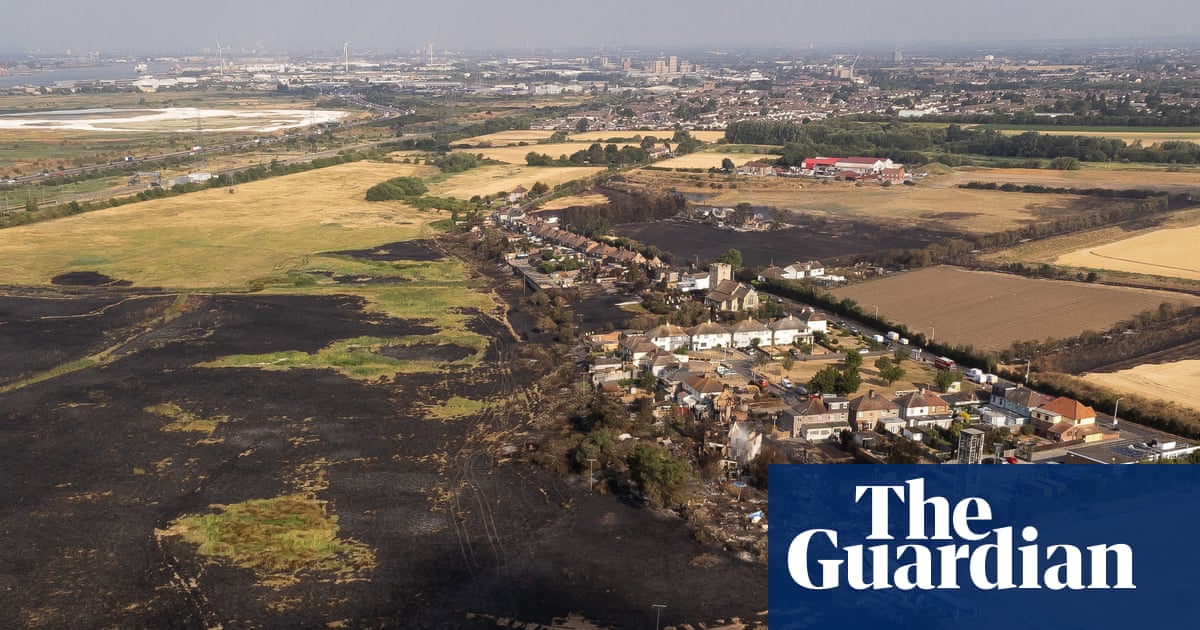
The Criminals and the Cowards
In 2022, the advertising giant WPP adopted a policy: it would not accept work "designed to frustrate the objectives of the Paris agreement." Since then, according to a detailed investigation by the climate platform DeSmog, WPP has helped ExxonMobil, Chevron, Shell and BP spend an estimated one billion dollars on US advertising — ads that a congressional investigation found were "deceptive and misleading," designed to thwart climate policy and maintain fossil fuel expansion.
This is not a policy failure. It is a conspiracy. And it will be treated as such.
The British state has used the charge of "conspiracy to cause a public nuisance" to imprison those who attempted to obstruct the destruction of the conditions for human life on earth–myself included. In the 2030s, as the scale of what has been locked in becomes undeniable, the corporations and institutions that were party to an agreement to mislead the public about the consequences of fossil fuel expansion will face the same charge — and the weight of evidence will be incomparably greater.
What will their punishment be? That question is worth sitting with.
The Adults Were Never in the Room
And presiding over all of this: a political class that staked its claim to power on being "the adults in the room."
Keir Starmer's Labour entered government in 2024 promising stability and seriousness. Less than two years later, it is facing an electoral wipeout. The promise of adulthood — steady, businesslike, non-threatening to those with power — turned out to be a pose constructed to reassure the right-wing press and the donor class. The actual work of governing was abandoned before it began.
But the problem runs deeper than Starmer. The entire language of "adults in the room" is a conman's gambit — ideological compliance dressed up as maturity. To be a "grownup" in Westminster means not troubling the rich, not naming the system as broken, not demanding what is actually needed. Corbyn was supposedly juvenile and Mandelson serious. Look where that led.
For more than a decade, the Guardian newspaper and the Western liberal class have produced and consumed accurate information about what is coming. The models were there. The projections were there. The peer-reviewed literature was there. And instead of entering into civil resistance, instead of using their platforms and their reach and their cultural authority to force a confrontation with power, they wrote columns calling for adults in the room.
That is not journalism. It's complicity, and will be remembered as such.
 Aditya Chakrabortty
What Is Actually Happening
Taken together, these seven stories are not the separate news items they are presented as but facets of a single, clouded reality.
New Orleans is sinking. The energy transition is a fiction. The political opposition to fascism is incoherent. The corporations paid to deceive the public are still being paid to deceive the public. The journalists who know we need radical change to avoid mass death keep calling for more moderate leadership. And the word that describes the likely scale of death, billions, is still being said only in appendices.
An adult is someone who can tell the truth and act as if the truth is real.
By that measure, there are very few adults in any room that matters. The rest of us need to become them. Fast, together, and without any further illusions about what the "nice life" is going to look like on the other side of what is coming.
The window to act is closing and pretending otherwise is no longer an option any serious person can afford.
If you want to read my latest on the corruption of the British state and its legal system, read my new book Suicide. Written in prison, now out in multiple languages.
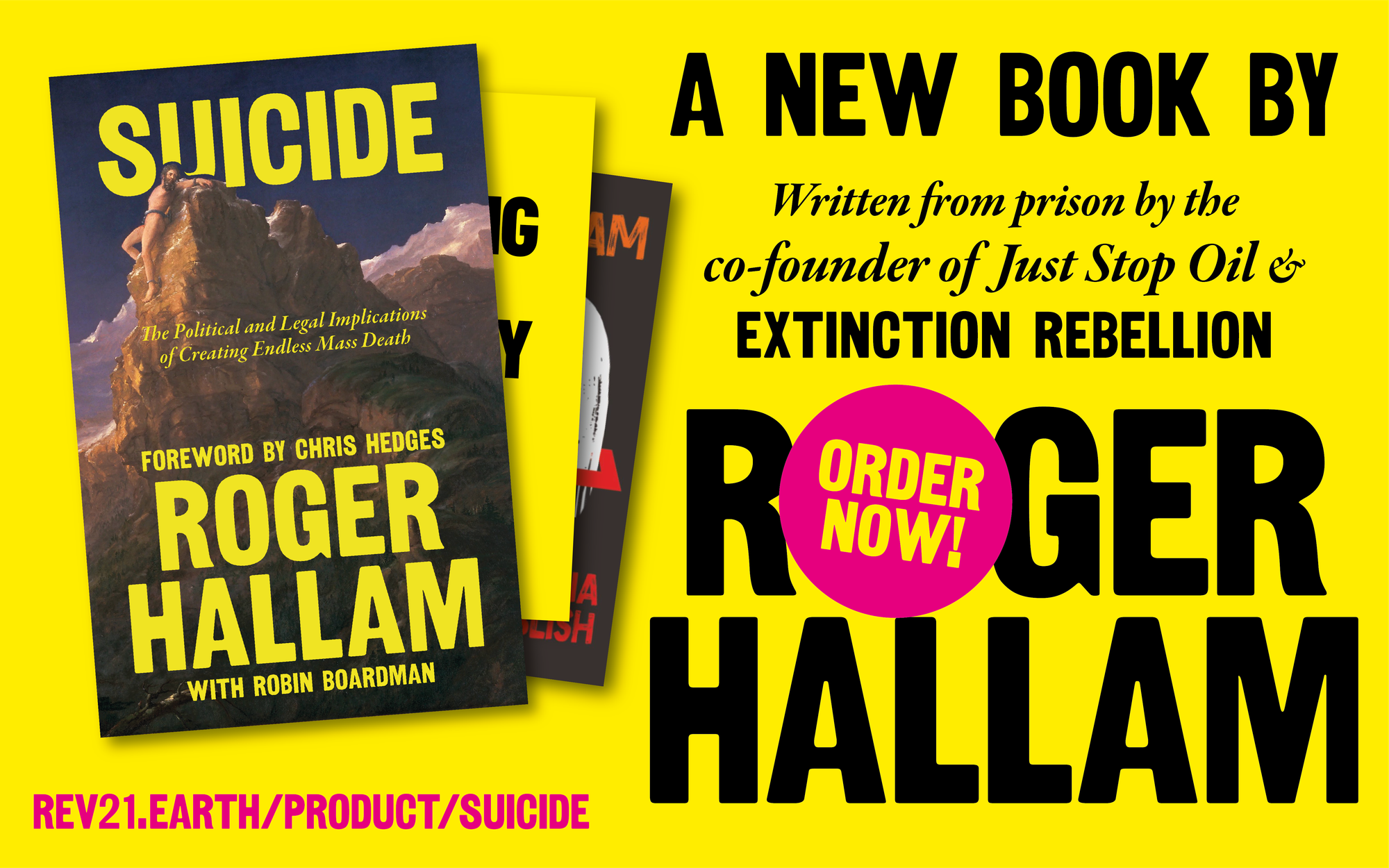
If you're a paid member of this blog, you can download the ebook below. If you a super donor of 20 a month, my team will send you all my books and the new ones as they come out. I hope you like it, and let me know your thoughts.